Showing posts with label "The Public Enemy". Show all posts
Showing posts with label "The Public Enemy". Show all posts
James Cagney's Final Act(ing)
After a thirty-year Hollywood career, James Cagney made what he thought would be his final film in 1961 -- a comedy directed by Billy Wilder called "One Two Three." Cagney then retired, spending his time between two farms he owned -- one on Martha's Vineyard and one in upstate New York. But Cagney got tired of being retired, and in 1980 his friend, director Milos Forman, talked Cagney into taking a small but significant role in Forman's film adaptation of the bestselling novel "Ragtime." Further encouraged by his family and lifelong friend Pat O'Brien, Cagney went on to play the lead role in a 1984 TV movie called "Terrible Joe Moran." By that point Cagney had been weakened by several strokes and was in a wheelchair, but he powered through, inspired by O'Brien's words of encouragement: "Do it, Cagney. It's medicine."
Sources:
"Cagney, 82, Is Embarrassed Anew at Being a 'Star'," Chris Chase, The New York Times, November 17, 1981
"Peter Gallagher," theavclub.com, June 14, 2011
"Ragtime," milosforman.com
"Ragtime," TCM.com
"TV Review: 'Terrible Joe Moran' Starring James Cagney," John J. O'Connor, The New York Times, March 27, 1984
"Faraway Fella: 'Cagney,' a Biography by John McCabe," David Thomson, The Los Angeles Times, January 4, 1998
Art Carney: A Biography, by Michael Seth Starr
Cagney, by John McCabe
"Cagney Felt at Home in Dutchess," Larry Hughes, Poughkeepsie Journal, June 18, 2015
"James Cagney: Looking Backward," Timothy White, Rolling Stone, February 18, 1982
"James Cagney's Condition Provokes Controversy," Sylvia Lawler, The Morning Call, March 25, 1984
Director Joseph Sargent on James Cagney, emmytvlegends.org
"Profile in Courage: Nobody Ever Said Cagney Wasn't a Fighter," Rod Townley, TV Guide, March 24, 1984
The "Public Enemy" Guide to Life
I think we can all agree that some movies offer great life lessons that we can tuck into our memory banks and carry with us, like loose change in our pockets or maybe lint, as we traverse through this unpredictable and awesome thing called life. I have found, for example, that the 1931 film "The Public Enemy" is stuffed like crazy with wisdom, and I can say without fear of contradiction that everything I need to know I learned from ... well, see for yourself.
 |
| Get regular exercise. |
 |
| No spanking unless its consensual. |
 |
| Be open to surprises. |
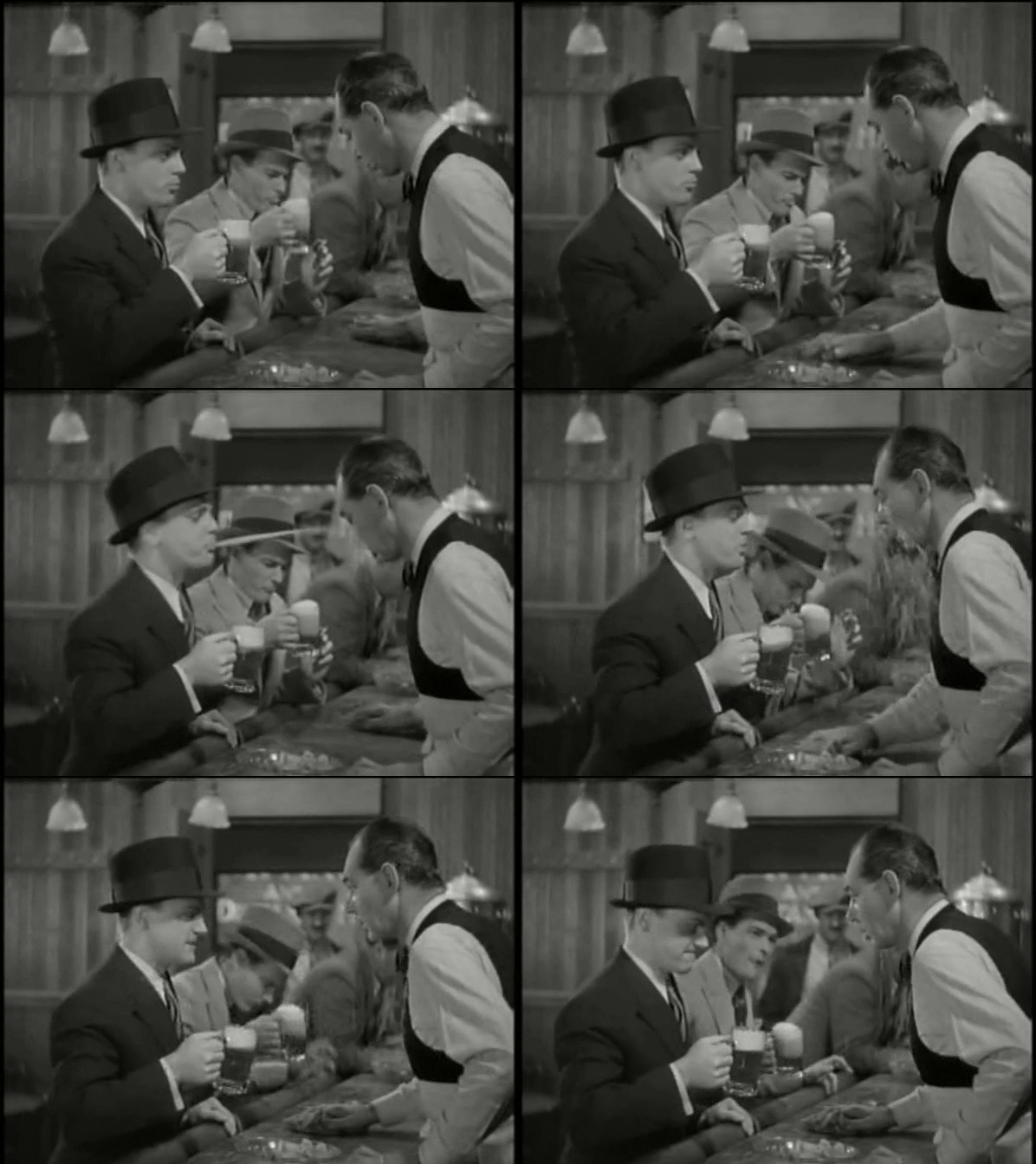 |
| Be respectful. |
 |
| Encourage your loved ones to make healthy food choices. |
 |
| Cultivate an appreciation for music. |
 |
| Again -- no spanking unless it's consensual. |
 |
| Be kind to your mother. |
 |
| And finally -- always celebrate Halloween. |
The Mae Clarke Film Festival: "The Good Bad Girl" and "The Final Edition"
 |
| "Don't tell anyone, but my real name is Mary Klotz." |
Of all the actresses who appeared in 1930s movies, Mae Clarke (1910-1992) was certainly one of them.
She played a variety of roles, including rather wooden reporter, rather wooden gangster's moll, rather wooden movie star, rather wooden bride carried away by Frankenstein and rather wooden prostitute. And she will go down in film history for this scene:

Clarke's kisser was a pretty one, and deserved -- and got -- better than a grapefruit half in most of her movies. She had the good fortune to appear in several true film classics, including "The Public Enemy," "Frankenstein," the first version of "Waterloo Bridge" and the original version of "The Front Page." She was capable of convincing work, but in average movies headed by average directors she tends to deliver her lines as if she was thinking about something else.
In the 1931 film "The Good Bad Girl" she gets to dip her toe into soap opera -- a territory dominated at the time by the likes of Kay Francis and Norma Shearer. She is Marcia, a reluctant gangster's moll. As the movie opens, she is trying to leave the big lug, but as Neil Sedaka so memorably said, breaking up is hard to do. Or, as the gangster (Robert Ellis) says, "There's only one way for either of us -- feet first," which does not have much of a danceable beat. Then the gangster leaves to settle a score with an old rival, which he does in kind of a memorable way:
The gangster wants Marcia to give him a fake alibi, but she refuses. She has fallen in love with another man (James Hall). The gangster is imprisoned and swears vengeance, and Marcia marries the other man even though he doesn't know about her past. When he and his high-society family find out, she is shunned, even though she's with child. Marcia has the baby, and the gangster escapes from prison, intent on tracking down and killing her. He makes it as far as the baby's nursery, where the police shoot him down like a dog. At the same time, rich husband has come to his senses and sets out to reconcile with Marcia.
"The Good Bad Girl" gives Clarke several opportunities to do some heavy-duty emoting, and she is convincing as the young mother set adrift. As Marcia's boozy pal, silent-film beauty Marie Prevost is aces with comedy relief, and things chug along until the inevitable happy ending:
In 1932's "The Final Edition," Clarke is reporter Ann Woodman, and the first part of her last name describes her performance. When she acts sassy or makes with a wisecrack, it's almost as if she doesn't understand it's a joke. Someone like Glenda Farrell would be knocking these lines out of the park, you get me?
Anyway, Ann wants to be a reporter but boyfriend Bradshaw (Pat O'Brien), who's also the city editor, doesn't think she's up to the job. Ann gets her chance when the new police commissioner is murdered and she jumps in to console the man's wife:
She scoops the competition with details about the murder and then she follows the killer to a resort hotel where he's hiding out. The bad guys catch on and she and Bradshaw end up in hot water, at least temporarily:
The newspaper picture was a stock-in-trade at Warner Bros., where O'Brien was under contract, so he fits right in, talking a mile a minute. For instance, try to decipher what he's saying here:
As for Clarke, her career continued into the 1960s, but with smaller and smaller roles. Her other credits include "Singin' in the Rain" (as a hairdresser), "The Catered Affair" (as a saleswoman) and "Pat and Mike" (as a golfer).
Here are full credits for "The Good Bad Girl" and "The Final Edition."
"Blonde Crazy" and the Art of Cagney
Fellow film scholars, I believe we can safely say that the 1931 film "Blonde Crazy" is the only one where this happens.

James Cagney's facemask is played by Joan Blondell's brassiere.
"Blonde Crazy," released just a few months after Cagney made a hit in "Public Enemy," shows a more playful side of the pugnacious star. My favorite movie actors -- Cary Grant, Burt Lancaster, Fred Astaire, Cagney -- have their own distinctive physical style, a special way of carrying themselves. At least part of Cagney's inspiration, he once said, came from the hopheads he'd see in his lower East Side neighborhood. But beyond that, Cagney was light on his feet and used his hands to accent his every move. And his training as a dancer showed up at the darndest times:

It's not hard to imagine that at least part of "Blonde Crazy" was made up as they went along, especially the interplay between Cagney and the ever-present Blondell. They both came to Warner Bros. from the Broadway play "Sinners' Holiday" and made at least a dozen films together, lending their relationships an easy realism.
In "Blonde Crazy" Cagney is Bert, an enterprising hotel bellhop always interested in picking up a quick buck. He even keeps a scrapbook of con schemes for easy reference. He is what today's kids would call a "baller."
Blondell plays Anne, who goes to work in the same hotel and reluctantly joins Bert in fleecing folks such as a lecherous traveling salesman (Guy Kibbee). And before you can say "pyramid scheme" the pair is working a counterfeit racket with Dapper Dan Barker (Louis Calhern). But then Dapper Dan pulls a con of his own, and the victims are Bert and Anne.
But Bert doesn't want to admit he's been taken, so he works a con of his own. He lifts a diamond necklace from a ritzy store and then hocks it. (He calls the pawnbroker "three balls.")
Meanwhile, Anne is falling for a bond broker (a young Ray Milland) who's a bit of a noodle. He sends her books of poetry, much to Cagney's delight:
And when Anne learns that Dapper Dan has given Bert the shaft, she sets up a little con of her own -- one with echoes of "The Sting" that involves horse races, off-track betting and license plates:
Written by John Bright and Kubec Glasmon, the men behind "The Public Enemy," "Blonde Crazy" has a couple of neat little con games interwoven with the love story between Blondell and Cagney. By the end of "Blonde Crazy," Bert is the hero despite his larcenous ways, and he has won Anne by making a huge sacrifice for her. It's the typical Cagney formula -- a charming, tough, good-bad guy.
Who can dance.
And do this.

Here are the complete credits for "Blonde Crazy" and a trailer:
Subscribe to:
Posts (Atom)