Showing posts with label Paramount Pictures. Show all posts

CMBA Fall Blogathon: "Make Me a Star," or Tom Nix


This is part of the CMBA Fall Blogathon: Hollywood on Hollywood! Check out all entries!

If "Merton of the Movies" isn't the first spoof of Hollywood, it comes close.

Harry Leon Wilson's 1919 novel about a naive small-town clerk who goes to Hollywood with a correspondence course in film acting under his belt and not much in his head was adapted for the stage in 1922 by George S. Kaufman and Marc Connelly. It was made into a movie in 1924 (with Glenn Hunter as Merton) and again in 1947 with Red Skelton in the title role.

In between, there was another version, 1932's "Make Me a Star." The cast alone is a Who's Who of early Hollywood -- Stuart Erwin, Joan Blondell, Ben Turpin, Ruth Donnelly, Zasu Pitts and Charles Sellon. William Beaudine directs -- a guy who began his career with Mary Pickford and ended it with the Bowery Boys.

In addition, there are fleeting, almost incidental cameo appearances by the biggest stars on the Paramount lot at the time -- Gary Cooper, Tallulah Bankhead, Claudette Colbert, Maurice Chevalier, Fredric March. Jack Oakie, Charles Ruggles, Sylvia Sidney and Clive Brook, among others.

We begin in the hamlet of Simsbury, two thousand miles and a world away from Los Angeles. Merton Gill (Erwin) is a rather preoccupied clerk who works for Mr. Gashwiler (Sellon) in the local emporium. Movies are on Merton's mind constantly, particularly B-grade westerns with humorless hero Buck Benson (Dink Templeton) -- so much so that Merton is given to whispering things to the horse pulling his delivery cart like "Let's get goin', Pinto, old pal -- we gotta make Red Gap before sundown."

Unfortunately, Merton's daydreaming leads to havoc at the store, what with messed-up deliveries and such. A frustrated Mr. Gashwiler finally gives Merton the boot and California, here he comes.

Merton goes directly to Majestic Studios, home of Buck Benson. He re-christens himself as Whoop Ryder and is befriended by stuntwoman "Flips" Montague (Blondell) and the studio's hard-bitten-but-kindly switchboard operator, The Countess (Donnelly). (One of the joys of this movie is listening to Donnelly say, in that testy manner of hers, "Now listen, Whoop.")

Flips helps Merton get a walk-on in a Benson picture; he blows his chance and is fired. But he won't leave the lot because he's afraid he'll never be let back in, and it's not like he has anywhere to go -- he's been kicked out of his apartment. By the time Flips sees him again, he's been sleeping on empty sets and is slowly starving.

Flips stakes Merton to a meal and gets an idea -- because Merton is such a straight arrow, he would make a perfect parody of Buck Benson. She sells it to a Mack Sennett-like producer and filming begins. Just one problem -- Merton thinks he's making a straight picture. He hates comedies and can't figure out why the cross-eyed Ben Turpin (playing a guy named Ben) is playing his sidekick.


On the eve of the premiere, Flips feels guilty.
She's fallen for Merton -- she calls him Trouper -- and can't bring herself to tell him the truth. So he faces it himself -- a theatre full of people laughing at him. He comes back to Flip and bursts into tears.

By now you may be getting the idea that "Make Me a Star" isn't quite a romantic comedy, or a slapstick comedy, or really much of a comedy at all. And I believe at least part of the fault lies with Erwin -- he's too vulnerable as Merton. You pity him, which isn't a good look for a hero. He's also frustratingly dense and a bit pompous.

On the other hand -- and this may be accidental -- "Make Me a Star" illustrates what it takes to be a success in Hollywood: sometimes the price is that you leave your real self behind. The movie leaves us up in the air -- we don't know if Merton makes another Whoop Ryder picture or not. And we're never quite clear just what the self-assured pro Flips sees in Merton.

The 1947 remake of "Merton of the Movies" takes place during the silent era, which with its outsize personalities and exaggerated acting styles is much easier to make fun of. The way Skelton plays Merton is easier to make fun of, too -- he's a genial dope who wins a contest and comes to Hollywood. In "Make Me a Star" Merton has been dreaming of coming to Hollywood all his life, which makes his failure even more poignant. All in all, "Make Me a Star" has a wistful sadness about it, and dares to float the idea that a Hollywood career doesn't guarantee a happy-ever-after ending.

Pre-Code Blogathon: "Love Me Tonight," or Some People Call Me Maurice

This is part of the Pre-Code Blogathon sponsored by Danny at Pre-Code.com and Karen at Shadows and Satin. Please visit either and/or both of them for more offerings. 


The 1932 film "Love Me Tonight" lets you know you are in for something special from the very beginning:


You haven't heard a word of dialogue, but the first few moments of the film set the stage perfectly -- Paris, morning, people waking up, a friendly man jauntily walking to his tailor shop and greeting his neighbors ("Hello Mrs. Bendix! How's your appendix?").

When it comes to modern life, I'm a firm believer in what Lily Tomlin once said: "No matter how cynical you get, it's never enough to keep up." And I love the cynicism of so many pre-code movies -- I think it's a period of filmmaking that mirrors the tenor of the times like no other.

But when I watch a movie like "Love Me Tonight," I happily park my cynicism at the door. It doesn't come easily to me, but the movie deserves sincere adjectives that I usually use sarcastically -- "delightful," "thrilling," "enchanting." It's a witty, lovely fairy tale with a prince named Maurice and a princess named Jeanette. It's not just one of my favorite pre-code movies -- it's one of my favorite movie musicals, period.

The pairing of Maurice Chevalier and Jeanette MacDonald brings to mind what Katharine Hepburn is alleged to have said about Fred Astaire and Ginger Rogers -- "he gives her class and she gives him sex" -- but in reverse. MacDonald's regal bearing (even when she wasn't playing a princess) and cultured soprano is perfectly counterbalanced by Chevalier's good humor and growly, untrained voice.

Their paths cross when Maurice pursues Charlie Ruggles as a deadbeat vicomte (French for "viscount," if you care) to his family castle, where the women -- Princess Jeanette and Countess Valentine (Myrna Loy, sexy as hell) -- are literally wasting away from lack of love. See for yourself:


Aunts in your plans of 1932.
The lord of the castle, the stern Duke (C. Aubrey Smith), keeps everyone in line, or so he thinks, and three maiden aunts (Elizabeth Patterson, Blanche Frederici and Ethel Griffies) are a Greek chorus commenting on the action. Princess Jeanette's only suitor is a hapless count played by the Hapsburg of the hapless, Charles Butterworth.

We are introduced to Princess Jeanette in one of my very favorite film moments -- the Rodgers and Hart song "Isn't It Romantic" travels from one singer to another, beginning on the lips of the hero and ending on the lips of the heroine:


This, to me, is exhilarating filmmaking -- storytelling in a style that still seems contemporary and clever. Taking a score by Rodgers and Hart consisting of songs that are spoken as well as sung, director Rouben Mamoulian worked with screenwriters Samuel Hoffenstein, Waldemar Young and George Marion, Jr. to shape the story around the music.

Truthfully, the story is the weakest part of "Love Me Tonight," but it's more than enough to carry the score and the performances. Maurice is a tailor. The viscount owes him money. He goes to the castle to get paid. Princess Jeanette is nearby, riding in a carriage and combining the lyrics of "Lover" with commands to her horse (I wish I had a clip to share with you) Maurice meets Princess Jeanette and falls in love.

She resists his advances and runs away. They meet again at the castle, where the viscount passes off Maurice as a baron. Everyone else in the castle loves Maurice as much as the princess dislikes him. How do we know? After he arrives, they all wake up the next morning singing "Mimi" -- even C. Aubrey Smith in what is undoubtedly his most joyous moment on film.

"Trust me. I'm a professional."
The princess finally comes around, falling in love with Maurice and then realizing, as he's fitting her for an impeccably-made riding habit, that he's a tailor. "Love Me Tonight" seems a little anticlimactic after that, though the plot turn does cause one character to say/sing, "I'd rather throw a bomb at her than have her wed a commoner."

Despite its atmosphere of sweet romance, "Love Me Tonight" does have its share of pre-code spice, including scenes of Loy and MacDonald in lingerie and other revealing outfits, some of which were trimmed during the movie's original release. And one raised eyebrow from Maurice Chevalier is worth a million double-entendres.

Here is the film itself (with commercials; sorry):


"She Done Him Wrong," or The Way West

As Lady Lou, Mae West first sashays into "She Done Him Wrong" -- and into pop culture history -- by entering Gus Jordan's Place, where she is the featured, um, entertainment. But first she stops to say hello to a child:


At moments like this I think of movie censor Will Hays.

See, "She Done Him Wrong" was based on West's Broadway hit, "Diamond Lil." But Hays didn't like that title. He had no problem with lines like the ones above, but he didn't like the title?!

So "Diamond Lil" became "She Done Him Wrong," one of those rare classic films that today's audiences respond to as gleefully as most theatregoers did in 1933. The movie comes on like an 1890s melodrama, but the woman at the heart of it is grounded in the pre-code 1930s -- if not the more sexually sophisticated 1970s.

And in 1933 "She Done Him Wrong" hit movie houses like a Vegas payoff.

By that fall, as the ad at left reports, the movie was held over or brought back by popular demand at more than 900 theatres -- a record that hadn't been equaled since "The Birth of a Nation."

The success of "She Done Him Wrong" has pretty much everything to do with the self-possessed Miss West. She floats above the trifling plot like a well-padded bubble, descending only to make spicy wisecracks, pitch woo with co-stars Cary Grant and Gilbert Roland and raise an eyebrow every so often.


Lady Lou loves men and diamonds, not necessarily
in that order, and surrounds herself with both. She is so treasured by saloon owner Gus Jordan (Noah Beery Sr.) that he has commissioned a large painting of her, scantily clad, for the saloon. Lou: "I gotta admit it's a flash, but I wish Gus hadn't hung it up over the free lunch."

Lou's juggling several men at the same time with a kind of genial insolence -- Gus, Captain Cummings of the local mission (Grant), a slimy political boss (David Landau), a suave Russian swindler (Roland) and her imprisoned old flame, Chick (Owen Moore). And when she isn't collecting diamonds from her admirers, she's taking the stage at Gus's to sing songs like "Easy Rider":


"I wonder where my easy rider's gone," a nice song about a missing jockey. Wait a minute -- could that have sexual connotations?! Apparently Will Hays didn't think so!

Lou goes to visit Chick in prison, and just the sight of her -- and the thought of what she's up to when he's not around -- drives Chick to escape and head to Jordan's place. Oh -- and there's also a counterfeit ring operating within the saloon, and an undercover cop who's trying to crack the case.

But really, none of that matters very much. Everything comes to a screeching halt to focus on Lou whenever she starts playing a guy, especially if it's one who looks like Cary Grant:


And in the end, when the counterfeiters are caught and the problem of Chick and the political boss are disposed of, we're left with Grant and West in a carriage:


Funny how the effect of him taking the diamonds and rings off of one hand has practically the effect of stripping her naked. 

Random thoughts that didn't fit anywhere:

"She Done Him Wrong" was directed by Lowell Sherman, who, that same year, directed "Morning Glory," for which Katharine Hepburn won an Oscar. Imagine working with Katharine Hepburn and Mae West within the same year. Sherman was also an actor, playing the doomed dipsomaniac director in "What Price Hollywood?" He died in 1934.


The Media History Digital Library is a great resource of vintage Hollywood fan magazines and trade papers. It's fun to look through them and see letters written in support of Mae West when the censors started circling like vultures. Here are a couple of my favorites:

What's this I hear about Mae West being "bad medicine" for our young girls? Who got the idea and from what source? Mae West simply has the ability to reveal all her beauty of character, her sweetness and womanliness in such an enchanting manner that men, young and old, go down on their knees. I'm for her. There is nothing about her wonderful performance to arouse antagonism.

M. Watkins, Elmore, AL
-- Hollywood magazine, February 1934

Everyone is talking about Mae West. Her curves, her beauty, her personality, her excellent selection of words. But do you know what I think? I think she is the most clever little psychologist in Hollywood. She has something for everybody. Fat to please fat ladies, beauty and personality for the thin ones and sex appeal and scanty costumes for the men.

S. Flanagan, Ventura, CA
-- Hollywood magazine, April 1934

Hmmm. I'm betting S. Flanagan is a guy.

"Three Cornered Moon," or Mother, Can You Spare a Dime?

A year before she won an Oscar as a madcap heiress in "It Happened One Night," Claudette Colbert played a not-so-madcap, not-so-much-of-an-heiress in "Three Cornered Moon." 

This 1933 film is an offbeat little gem, a kind of screwball ensemble drama that showcases just about everyone -- Colbert, Mary Boland, Wallace Ford, Tom Brown, William Bakewell, Hardie Albright -- at their best. (The male lead, Richard Arlen, is passable but he always seemed more comfortable in action roles -- here, as a romantic lead, he's punching a little above his weight.)

"Three Cornered Moon" is like an upper-class version of "You Can't Take It With You," but without the too-studied (to me, at least) eccentricities of the Sycamore clan.

Our family here is the Rimplegars, who occupy a comfortable almost-mansion in dear old Brooklyn back in the days when it was filled with almost-mansions. Papa Rimplegar, who ran a prosperous laundry, is gone, and devoted but dotty mother Nellie Rimplegar (Boland) thinks nothing of wearing a fringe-y dressing gown while mixing waffle batter, or of ordering taxis by the handful to accommodate the transportation needs of her grown children -- grounded-but-idealistic Elizabeth (Colbert), law student Kenneth (Ford), aspiring actor Douglas (Bakewell) and student Eddie (Brown). Lyda Roberti is the family's Polish maid, Annie.

The family leads a life of slightly rumpled elegance. Everyone assumes that their financial needs will always be met. Free of burdens like having to work at a job, Elizabeth spends her days with fiancee Ronald (Albright), a suffering writer who's a literary genius in the making -- just ask him. ("You write like a tree on fire!" Elizabeth says in what is supposed to be a compliment.) Together they sit in the park; between them, they try to whip up some existential angst:


Meanwhile, back at Rimplegar almost-mansion, reality is about to come crashing in the door because the family finances have been handed, unfortunately, by Nellie. And suddenly the money is gone -- thanks largely to a hefty investment Nellie made in a worthless mine called Three Cornered Moon.

So the Rimplegars are flat busted, and everyone (except Ronald the writer) scrambles to help. Douglas the actor gets a role in a play that consists of one word: "Yes." In this wonderful scene, he rehearses his heart out as a sympathetic Nellie watches, and does a little dusting:


Eddie gets a job as a lifeguard, and starts avoiding meals, which isn't such a good idea. Elizabeth wangles a job in a shoe factory where, like all the other working girls, she must withstand the unwelcome advances of her boss, or lose her job:


The family's one financial saving grace during this period is family friend Dr. Stevens (Arlen), who rents a room in the house, mostly because he's in love with Elizabeth. And when Nellie accidentally ruins dinner one night, the objective becomes to obtain the good doctor's rent money:


Then a family crisis results from Eddie's lack of food, and a plum job is offered to Ronald the writer. Will he sacrifice his artistic sensitivity to the workaday world for the greater good, or be a selfish boob? And there is another possible financial boost -- if Kenneth can pass his bar exam. On the day when the exam scores appear in the paper, everyone gathers round:


One of the many nice things about "Three Cornered Moon," beyond the ensemble performances and the dialogue, is its resolutely un-magical ending. In other movies, the family might somehow get its investment money back. Here they don't. And darned if they still don't end the movie better off than they were in the beginning.


"Movie Crazy," or Lloyd Bridges

In the 1932 film "Movie Crazy," pre-code meets pre-pre-code.

As small-town boy Harold Hall, Harold Lloyd plays the same sincere, guileless but resourceful character he played in silent films. He's followed his star to Hollywood, where he wants to break into pictures in the worst way.

Lloyd's character is right out of the early 1920s, but the people he meets -- particularly actress Mary Sears, nicely played by Constance Cummings -- are right out of a wisecracking pre-code movie. Mary ends up falling for Harold in spite of herself because he's so genuine, and so accident-prone -- her nickname for him is "trouble" -- and she provides great sarcastic commentary as she watches his pratfalls. As a result, "Movie Crazy" nicely bridges silent and pre-code comedy.

We begin in Littleton, Kansas, where Harold lives with his parents. He mistakenly sends someone else's photo -- an all-American good looker -- to a Hollywood studio in hopes of getting an audition. The studio extends an invitation and Harold is on a train at once.

Harold has hardly stepped off the train before he's tapped to be an extra in a movie scene being shot at the station. The stars are pompous matinee idol Vance (Kenneth Thomson) and Mary, in heavy makeup as a Spanish maiden. As you might expect, Harold ruins every take in practically every way possible, from tripping over the leading man to pulling down a stack of noisy metal milk cans.

Then we cut to the studio, where Harold meets Mary, out of makeup. It starts raining and Harold "helps" her put up her convertible top:


Harold ends up back at Mary's place, where she takes pity on him and lets him inside to get dry. He has a seat, and reminds us that thanks to his silent movie training he still knows how to take a fall:


Lloyd stays true to his long-established character in "Movie Crazy" -- his best comic moments come in largely silent slapstick sequences. My favorite part of the film is his screen test, a series of botched takes. All he has to do is enter and answer the phone, and he blows it beautifully:


Harold doesn't know that Mary is also the Spanish woman -- he thinks they're two different people.
Mary keeps teasing him while dressed as her Spanish character, and he never pushes her away convincingly enough, so Mary dumps him. This leads to a sequence at a fancy dress ball. Harold mistakenly thinks Mary has invited him, and he ends up putting on a magician's jacket by mistake. In echoes of the formal dance sequence in Lloyd's "The Freshman," his coat unleashes chaos at the party and he endures the ultimate humiliation of being thrown out and rejected by Mary.

As is the patten in this kind of movie, Harold's triumph follows a few minutes later -- he ends up in a fight with Vance, his rival for Mary. He doesn't that it's being filmed, on a set that's supposed to be a sinking ship. Again, Lloyd's visual gags carry the day:


By the end of the picture, Lloyd is back in good graces with Mary and the studio. The kid from Kansas has stayed true to himself -- in a pre-code world he's gotten ahead by sticking to his own code.

Here are the full cast and credits for "Movie Crazy."

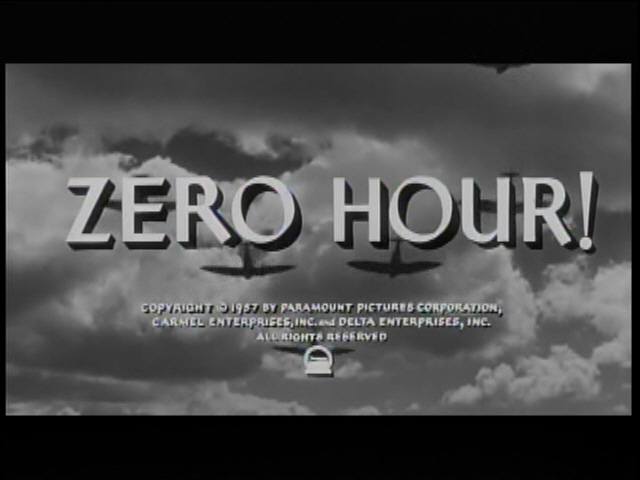
"Zero Hour!" or Halibut Not for Me

A great film tells its story solely through visuals.

And I guess the 1957 movie "Zero Hour!" does, too.


Herewith we present the film in a unique pictorial form utilizing pictures of a visual nature designed to tell the story through images in a visual, pictorial manner that includes the use of pictorial images that are visual.

Our story begins on a beautiful day during World War II.

Dana Andrews plays Ted Stryker, a World War II squadron leader who
caused all of his men to crash. A lot. Now he is haunted and stuff.

Stryker's wife (Linda Darnell) is tired of having a haunted husband,
so she has taken son Bobby and left Stryker. Little does she know that the plane
 they have boarded is on a flight to disaster, with 
a quick connection at Kansas City. 

In pursuit of his wife and son, Stryker boards the same plane and ends
up sitting next to Rob Petrie's neighbor, Dr. Jerry Helper.


Bobby visits the cockpit, where co-pilot Clutch Cargo gives him a toy plane.

Jerry Helper has a neurotic condition where he can talk only through his
puppet, Dr. Yarnfinger. When asked whether he wants halibut or lamb chops
for dinner, Dr. Yarnfinger 
chooses lamb chops. Well played, Dr. Yarnfinger.


The special effects could be better.


Turns out most of the passengers and both of the pilots have eaten
bad halibut and have food poisoning. To save his family,
Ted Styker must fly a plane again!

Unfortunately, it's been so long since Stryker flew that he's forgotten
where his ears are -- and that, for best results, a pilot's eyes must be open.


And yet Stryker's wife bravely supports him every step of the way.
Stryker gets off to a rough start, and knows that only one man can help him ...

... Gen. Jack D. Ripper. He knows Stryker's history, and even gave him an affectionate
nickname -- "cowardly pilot-killing incompetent sissy who crashes a lot." He is the ideal man
to instill confidence in Stryker.

A doctor on board tries to distract the passengers with a singalong:
"Who knows 'The Wreck of the Edmund Fitzgerald'?"

The passengers seem calm ...


"Dr. Yarnfinger ate halibut off of someone's plate and he
has food poisoning, too. He's doing weird things down my sleeve." 


Ripper tells Stryker that thanks to the potency of his bodily fluids,
he's doing a great job, and pay no attention to the hundreds of emergency
vehicles lining the runway. They're just curious because they've never seen
a disastrous crash before. 
Finally the plane makes a smooth, relaxed landing.
And who knew this was one of those experimental planes
that used fire instead of landing gear?
Somebody's gettin' a little somepin-somepin tonight, oh yeah.

"Wait till Dr. Yarnfinger tells Millie about this!"


"Trouble in Paradise," or The Snatch Game

"Trouble in Paradise" bugs me, man.

Writing about it bugs me, that is. It's such a flipping perfect little movie that I can't make affectionate fun of it the way I do with awkward early talkies, or Joan Crawford's bug eyes, or Marie Dressler's mugging. It forces me to resort to phrases that aren't part of my vocabulary as a cynical middle-aged guy in the early 21st century but that nevertheless are accurate, like "beautifully constructed," "sublimely witty" or "delightfully acted." Or descriptors that you usually use when talking about desserts, like "exquisite" and "fluffy" and "delectable."

Worst of all, I lack even an iota, a scintilla, a microscopic speck of the skill of the people behind the movie, particularly director Ernst Lubitsch, from whom all blessings flow, so how can someone so humble report adequately on something so special? Who do I think I am, Self Styled Siren? It falls to me to try and write about a movie I love while knowing that my pitiful efforts at describing why it's so special will never, ever, ever do it justice.

Having now built your expectations to a fever pitch, let us hie to Venice, where a night of magical romance is just about to go through cupid's checkout counter (12 items or less). We are in a hotel where the Baron (Herbert Marshall), a smooth customer with half-lidded eyes and a perpetual half smile, is ordering dinner from a willing waiter:

Baron: It must be the most marvelous supper. We may not eat it, but it must be marvelous.

Waiter: Yes, Baron.

Baron: And waiter --

Waiter: Yes, Baron?

Baron: Do you see that moon?

Waiter: Yes, Baron.

Baron: I want to see that moon in the champagne.

Waiter: Yes, Baron. (writes) Moon ... in ... champagne.

Baron: And as for you --

Waiter: Yes, Baron?

Baron: I don't want to see you .. at all.

Waiter: No, Baron.

The dinner guest arrives. It is the Countess (Miriam Hopkins), looking beautiful and breathless because she just succeeded at barely avoiding someone she wanted to avoid. Someone with a title and an estate, no doubt, but uninteresting -- the kind of ne plus ultra people who attend so many of the ne plus ultra parties she is forced to attend, in case you were wondering.

The Countess and the Baron circle each other, taking turns with mutual compliments and pleased smiles. Then comes moon-infused champagne, and dinner, and some straight talk:

Countess: I have a confession to make to you: Baron, you are a crook. You robbed the gentleman in 253, 5, 7 and 9. May I have the salt?

Baron: Please!

Countess: Thank you.

Baron: The pepper, too?

Countess: Oh, no, thank you.

Baron: You're very welcome. Countess, believe me, before you left this room, I would have told you everything. And let me say this, with love in my heart: Countess, you are a thief. The wallet of the gentleman in 253, 5, 7 and 9 is in your possession. I knew it very well when you took it out of my pocket. In fact, you tickled me. But your embrace was so sweet.

The Baron is actually Master Thief Gaston Monescu, and the Countess is actually Lily the Very Good Pickpocket. They are con artists, and each thrilled to be in the company of a master, so they become a couple.

Fast forward to Paris, specifically Colet and Company, makers of cosmetics. This is the business owned by the third side of our triangle, Madame Colet (Kay Francis). Her husband started the business, but now he's dead, and Madame isn't that interested in it. Neither is she interested in her two persistent suitors, the Major (Charlie Ruggles) and Francois (Edward Everett Horton). She gets joy mainly by buying beautiful things, and when her very expensive evening bag goes missing at the opera, she offers a large reward. The rewardee is Gaston, but when he meets Madame he senses the potential for more than just a reward:


Gaston: Madame Colet, if I were your father, which fortunately I am not, and you made any attempt to handle your own business affairs, I would give you a good spanking - in a business way, of course.

Madame: What would you do if you were my secretary?

Gaston: The same thing.

Madame: You're hired.


Gaston becomes Madame's live-in financial secretary. And Lily is hired as a stenographer. But when Madame confides her feelings about Gaston to Lily, the Very Good Pickpocket starts getting a little antsy.

Meanwhile, there are signs the jig, she is up. You see, on the night Gaston and Lily first met, in Venice, Gaston had just come from robbing a silly rich man in the same hotel, and it was Francois -- the man in room 235, 7 and 9. And since Francois is always hanging around Madame Colet, he meets Gaston and starts putting two and two together, but not without great difficulty.

At any rate, Gaston and Lily sense that it's time to go. But to Gaston, known to his mistress as Monsieur Laval, Madame Colet has become more than just an attractive target, and he takes appropriate action:  

Gaston: Is this the Petite Flower Shop? I want you to take five dozen roses -- deep, red roses. And I want you to put them in a basket, and send this basket tomorrow morning to Madame Colet. And attach a card: "In memory of the late Monsieur Laval." Tomorrow morning. Ten o'clock. Yes. Huh? Oh -- charge it to Madame Colet.

Truth be told, Gaston does not leave Madame Colet that abruptly. He does it with the kind of wit and style that marks "Trouble in Paradise" beginning to end. I've tried to recount some of it, but compared to the finished film my efforts are like those of the first fellow we see in the movie, an opera-singing Venetian piloting a gondola overflowing with garbage through a moonlit canal.

Oh, and one more thing -- Kay Francis has the cutest little speech impediment. You really notice it toward the end of the movie, when she turns to Gaston and says:

"Why talk of wobbewy on a night like this?"

Why indeed.

Here are complete credits for "Trouble in Paradise."

"The Story of Temple Drake," or Oh Brothel, Where Are Thou?

Around about 1932-33, Miriam Hopkins achieved what we might call a pre-code movie hat trick by appearing in three notorious examples -- "Trouble in Paradise," "Design for Living" and "The Story of Temple Drake."

The latter film, especially, is credited with being the straw that broke the pre-code camel's back, leading to the formation of the National Legion of Decency and the enforcement of strict movie censorship that would last until the mid-1950s. And even from the vantage point of 80 years, "Temple Drake" still packs a punch. Its lurid story deals with all kinds of pre-code hot button issues -- rape, incest, prostitution, illegitimate children, murder and agriculture.

We open down south in Dixon County, where Temple Drake (Hopkins) lives. She's a rich ninny -- the silly granddaughter of a local judge (Sir Guy Standing) who uses her beauty and his status to get pretty much anything she wants. Her life is a merry social whirl -- big parties! Late night revels! Formal dances with Grady Sutton!

Judge Drake is a respected figure, but he's not above sharing a shot of sour mash in his chambers between trials. And he's concerned about Temple's wild ways, but when she tells him not to worry, that the man she's out carousing with attends the judge's alma mater, he calms down.

Temple actually does have a secret love -- local attorney Stephen Benbow (William Gargan), who's noble enough to act as a public defender for those too poor to afford representation. At a ritzy party, Temple confesses to Stephen about her feelings for him, but she also talks about her untamed wild side. It's like the original "It isn't you, it's me" speech:


And once she confesses to Stephen, Temple goes back to the wild side of her personality, leaving the party to go for a joyride with Toddy (William Collier, Jr.), the drunken college boy from the judge's old school. Then there's an accident, and Toddy and Temple end up stranded at an abandoned plantation that looks like Scarlett O'Hara's place after the Civil War.

Living in the crumbling house is a motley crew -- bootlegger Lee Goodwin (Irving Pichel), slow-witted Tommy (James Eagles), Goodwin's common-law wife Ruby (Florence Eldredge) and their baby, and, most dangerous of all, the predatory Trigger (Jack LaRue), a small-time hood.

A storm is raging outside, and Temple is totally at sea -- for the first time in her life, she's trapped in a world where "I'm Judge Drake's granddaughter" doesn't mean anything. She tries to protect herself by staying with Ruby and her baby, who's sleeping in a wood box in the kitchen.

Temple: Why do you keep the baby in a wood box?

Ruby: So the rats won't get it.

Temple finally goes out to the barn and falls asleep in the corn crib. The simpleminded Tommy watches over her. But the snakelike Trigger is persistent, and we know there's trouble brewing when we see his shiny street shoes sliding across the hay-covered floor:


 Trigger kills Tommy and attacks Temple, and then he and a shellshocked Temple drive over a county or two and take up residence at Miss Reba's House of Ill Repute, Inc. It's interesting to look at the music on the soundtrack at this point -- up until now, Temple's trials have been punctuated by a nondescript orchestral score, but once we get to Miss Reba's all we hear in the background is a honky tonk piano. And somehow, it makes things seem even more nightmarish:


Meanwhile, back in Dixon County, the official story is that Temple's away visiting relatives. And Stephen remains the sole defender of Temple's honor, going into men's rooms and wiping "Temple Drake is just a fake/She wants to eat and have her cake" off the walls.

Then Lee Goodwin is charged in the murder of Tommy, and Stephen becomes his attorney. He sets out to find eyewitnesses. His trail leads to Trigger, and he's shocked to see Temple shacking up with him. Temple places herself between Trigger and Stephen to keep Trigger from shooting him, and tells Stephen she loves Trigger. Stephen leaves and Temple decides she's had enough. She puts on her hat to leave, but Trigger blocks her and starts pushing her around, and she shoots him. Then she tries to leave, but she realizes he's holding her hat:


Temple makes her way back to Dixon County, where Stephen calls her as a witness in Lee Goodwin's trial. But they both know that if she tells the truth, her reputation will be ruined. "Give me a chance to live it down," she pleads to Stephen -- and he has to decide whether he will serve justice or spare the woman he still loves.   

"The Story of Temple Drake" is based on William Faulkner's novel "Sanctuary," and considering what it couldn't include from the book, it very effectively retains the Southern Gothic flavor of Faulkner. Hopkins must have drawn from her experience as a native of Savannah, Georgia in conveying Temple's lethal charm.

And props, please, to Jack LaRue, who was given the part of Trigger when George Raft refused it. In a career of thankless roles, always as the bad guy, he actually seems half-human -- flattered and even slightly vulnerable -- in the scene where Temple pretends to be in love with him in order to save Stephen.

Here are complete credits for "The Story of Temple Drake," which by the way almost disappeared after its initial release. A restored version, courtesy of the Museum of Modern Art, premiered at the Turner Classic Movies Film Festival in 2011.    


"City Streets," or Gang Man Style

The 1931 film "City Streets" is blessed visually in several ways. One is by the smooth, innovative direction of Rouben Mamoulian, who in this film introduces one storytelling technique that today's movies are still using. Another is the atmospheric photography by Lee Garmes, who also shot "Scarface," "Gone with the Wind" and "Nightmare Alley." And then there's the presence of a tall, handsome drink of water named Gary Cooper.

Cooper plays a character called simply "the Kid" -- a straight shooter who also happens to be a crack shot. At this point, Cooper was also a legendary ladies man, with a line of conquests that included Clara Bow and Lupe Velez, and it's easy to see why -- aside from his physical attractiveness, he radiates strength and confidence.

Born Frank Cooper in Montana, our hero took up horseback riding as a kind of physical therapy to recuperate from a hip injury he suffered in a car accident. This made him a natural for western roles, such as in "The Virginian" and "The Man From Wyoming," but his cowboy's nonchalance wasn't restricted to the range -- for instance, as a Foreign Legionnaire taken by Marlene Dietrich in "Morocco," he might as well be wearing chaps.

"City Streets" begins with the Kid working at a carnival, where he runs the shooting gallery and amazes the spectators with his trick gun work. His best girl is Nan (Sylvia Sidney). She's a good kid with just one fault -- she's loyal to her nogoodnik stepfather (Guy Kibbee), who works as a "bodyguard" for bootlegger Big Fella (Paul Lukas).

Big Fella's catchphrase is "no hard feelings," which is gangster-speak for "very hard feelings indeed, and you will be riddled with bullets as soon as I can step out of the way." We first get a look at Big Fella as he's collecting protection money from a reluctant client:


I think we all know the moral to this story: never get your hat personalized.

Nan and the Kid want to get married, but they can't on his gallery salary. She tries to talk him into joining Big Fella's gang, but he's reluctant. Then when Big Fella's main rival is killed with stepfather's gun, Nan's loyalty is put to the test. She's found guilty of withholding evidence and is sent to prison. While there, she sours on the mob and is grateful that the Kid isn't mixed up in it. But he is. He tells her the news during a prison visit, and later that night it's still rattling around in her head:


(The voiceover in Nan's head is making its first movie appearance. Nicely done, Mamoulian.)

Once Nan is released from stir, she wants to pry the Kid loose from Big Fella's clutches. But Big Fella is more interested in getting his clutches around Nan. The Kid and Big Fella have a showdown over Nan, and Big Fella decides its time to rub out the Kid. But Nan pretends to be interested in Big Fella in order to save the Kid's life. Then one of Big Fella's old girlfriends (Wynne Gibson) shoots him and frames Nan. Everybody wants to nab Nan, but the Kid takes control of the mob in this skillfully edited scene:


"City Streets" is based on a Dashiell Hammett story and adapted by Max Marcin, the man behind the "Crime Doctor" radio and film series of the 1930s and '40s. It has the narrative drive you'd expect from a Warner Bros. gangster movie with the European visual flair of a Paramount film. That style flows all the way through to the final scene -- the Kid and Nan have escaped from the mob and crank up Wagner on the car radio as the camera pans up to birds circling in the sky.

Here are full cast and credits for "City Streets."

"If I Had a Million," or A Taste of Money

In the 1932 film "If I Had a Million," a cantankerous millionaire (Richard Bennett, the real-life father of actresses Constance and Joan Bennett) decides to stiff his greedy relatives and leave a million dollars to eight people picked at random from the city directory.

It was a big year for "all-star" films. MGM released three -- "Grand Hotel," "Dinner at Eight" and "Night Flight." And Paramount's entry into the sweepstakes included a cast of studio contract players ranging from W.C. Fields to a young Gary Cooper.

The episodes range from comedy to tragedy. There's melodrama in the segment with Gene Raymond as a convict on death row who gets to endorse the check just before he gets the hot seat. There's irony in the segment with George Raft as a check forger who slowly goes crazy because he can't get anyone to believe that his check is legitimate. There's a bit of sadness in the segment with Wynne Gibson as a prostitute who uses her money to finally rent a hotel room and sleep by herself. And there's poignancy in the segment with May Robson, who uses her money to change the bleak old folks' home where she's trapped into an exclusive club for older women.

But for my money, the best segments are the comedies, directed by Ernst Lubitsch and Norman Z. McLeod.

"Plhphluuuuuuuuuuu."
Lubitsch's segment, with Charles Laughton as a clerk who quits his job by giving the big boss a well-earned raspberry, is short and sweet.

Then there's the segment with Charlie Ruggles as the put-upon clerk in a china shop. He's been reluctantly promoted from the accounting department, and he keeps breaking the merchandise, which is subtracted from his salary. At home he is henpecked by wife Mary Boland, at her Mary Boland-iest. This leads to nightmares:


Once Ruggles gets his million, he gleefully destroys the store. And the film's other outstanding segment also features generous destruction. W.C. Fields and Alison Skipworth play a couple who use their million to finance a crusade against road hogs (bonus -- lots of cool footage of the Southern California landscape circa 1932):


Finally, there's a good look at a young Gary Cooper in the segment where he, Jack Oakie and Roscoe Karns play roughneck Marines who think the check is a joke:


Here's a complete cast listing for "If I Had a Million."