Showing posts with label Cliff Edwards. Show all posts

Awkward Early Talkie Theatre: "Children of Pleasure"

The 1930 MGM film "Children of Pleasure" tries to whip up big-city razzle dazzle in the manner of the same studio's Oscar-winning "The Broadway Melody" or "Chasing Rainbows," but due to a wan leading man and subpar musical numbers (including one where the dancers are dressed as brooms), the effect is more like a handful of confetti shaken out of a pant cuff by a surly headwaiter.

The leading man, Lawrence Gray, is a handsome fellow who supported Marion Davies in her first talkie, 1929's "Marianne," and who played opposite Marilyn Miller in "Sunny," one of the year's top-grossing films. But left to his own devices, Gray has little more than a smile and a shoeshine, and a mildly pleasant singing voice.

Gray plays songwriter Danny Regan, whose tunes are being whistled by every Dick and Dora along the great white way. "That's the stuff!" they say in unison. Yes, the world is Danny's oyster -- he even knows Jack Benny (playing himself)!


Danny's big hit at the moment is "A Couple of Birds (with the Same Thing in Mind)," sung in a Broadway revue by Fanny Kaye, played by May Boley. This is Boley's only musical role, which should tell you something. Her other credits include the 1930 film "Moby Dick" (as Whale Oil Rosie) and the 1939 version of "The Women" (as woman under mud pack). From its heard-it-before rhythms to its blackface chorus, "A Couple of Birds" is highly missable.

Meanwhile, back at Danny's music publishers, we meet the warm, vivacious Emma (Wynne Gibson), Danny's former vaudeville partner who secretly lurrves him as she helps him put over his songs. Alas, Danny has met Pat (Judith Wood, acting under the name Helen Johnson), a rather chilly society girl, and the big sap falls for her like a tycoon jumping off a ledge on Black Thursday.

Then there is more plot -- we're introduced to Fanny's piano player and reluctant lover, Andy (Benny Rubin). Fanny and Andy keep popping up to banter about Andy's roving eye.

Fanny (on Andy ogling a secretary): You never looked at me like that!

Andy: You never looked like that!

A production number based upon
particulate matter.
Danny pitches his next big number, called, um, "Raisin' the Dust." And brother, it's sweeping the country! Or at least this soundstage, where the chorus girls wear broom bristles on their arms and legs and rhyme "hades" with "ladies." What fun this must have been to shoot.

At the end of the number, Fanny -- wearing a one-horned hat that makes her look like a cockeyed unicorn -- brings Danny on stage, and in the audience he sees Pat again, much to Emma's disappointment. Danny and Pat finally formally meet at a night, where we also get a number with Lawrence Gray, Wynne Gibson and Benny Rubin.


(Because I can never resist including a number that ends with a joke about "my fanny.")

Anyway, before you can say "Why in the world would you want to marry an iceberg like her?", Danny and Pat are engaged. But she's still hanging around with old flame Rod (Kenneth Thomson playing the same kind of smarmy rich guy he plays in "The Broadway Melody"). And just before the ceremony Danny overhears Pat and Rod making baby talk, and Pat telling Rod "you're Danny's understudy." So the heartbroken Danny breaks up the wedding rehearsal, giving Gray his only opportunity in the movie to display emotion that isn't expressed by a smile.


But never fear -- Danny turns to the long-suffering Emma to relieve his broken heart.

"Children of Paradise" is based on the play "The Song Writer," which author Crane Wilbur based on the courtship of Irving Berlin and heiress Ellin MacKay. The plot of the movie-play turns out differently than the Berlin-MacKay affair -- despite the strong objections of her anti-semitic father, MacKay and Berlin were married more than 60 years, until her death in 1988 (he died the next year). In a bit of poetic justice, Berlin reportedly helped his father-in-law financially when the old guy was wiped out by the 1929 crash.

As for Gray, his career faded quickly and he ended up in grade-C westerns before dropping out of show business in the mid-1930s.


The "Seven Miles from Alcatraz" Guide to Fighting Nazis

You never know when Nazis might make a comeback, so we turn to the 1942 film "Seven Miles From Alcatraz" for advice on what to do when goose steppers appear on your doorstep.

Greetings, everyone! My name is Champ. I am an escaped
prisoner and Nazi-fighting expert extraordinaire.
I also have a yen for yachting attire. 

My story begins at Alcatraz, where my friend Jimbo and
I are sitting out World War II -- OR SO WE THOUGHT!


Our troubles started when we busted out of Alcatraz one night.
The movie's budget isn't big enough to show you how we
actually did it.

All you get to see is the packing crate we hid under
to make our escape. As as inside joke, they put the name
of the producer on the crate. That's why the prop guys had
so much fun shooting holes in it.

We ended up at a lighthouse that was SEVEN MILES
FROM ALCATRAZ. Here we found the captain, his
daughter Anne and comic sidekick Stormy. aka the voice of Jiminy
Cricket. We punched him out because "Pinocchio" made us cry.

Meanwhile, in San Francisco, several Nazis were getting
ready to head our way and rendezvous with a German sub. 

I started warming up for the big fight the way I used
to with Jimbo back on the Rock.

Once the Nazis arrived, the other folks didn't quite know
how to fight them.

"Go away or I'll sing 'When You Wish Upon a Star"!"


"Go away or I'll throw myself off the top of the lighthouse!"


"Go away or I'll kiss this girder!"


Things were getting weird. And when one of the Nazis
unplugged the radio because he didn't like "Fibber McGee
and Molly," well, that was the last straw.

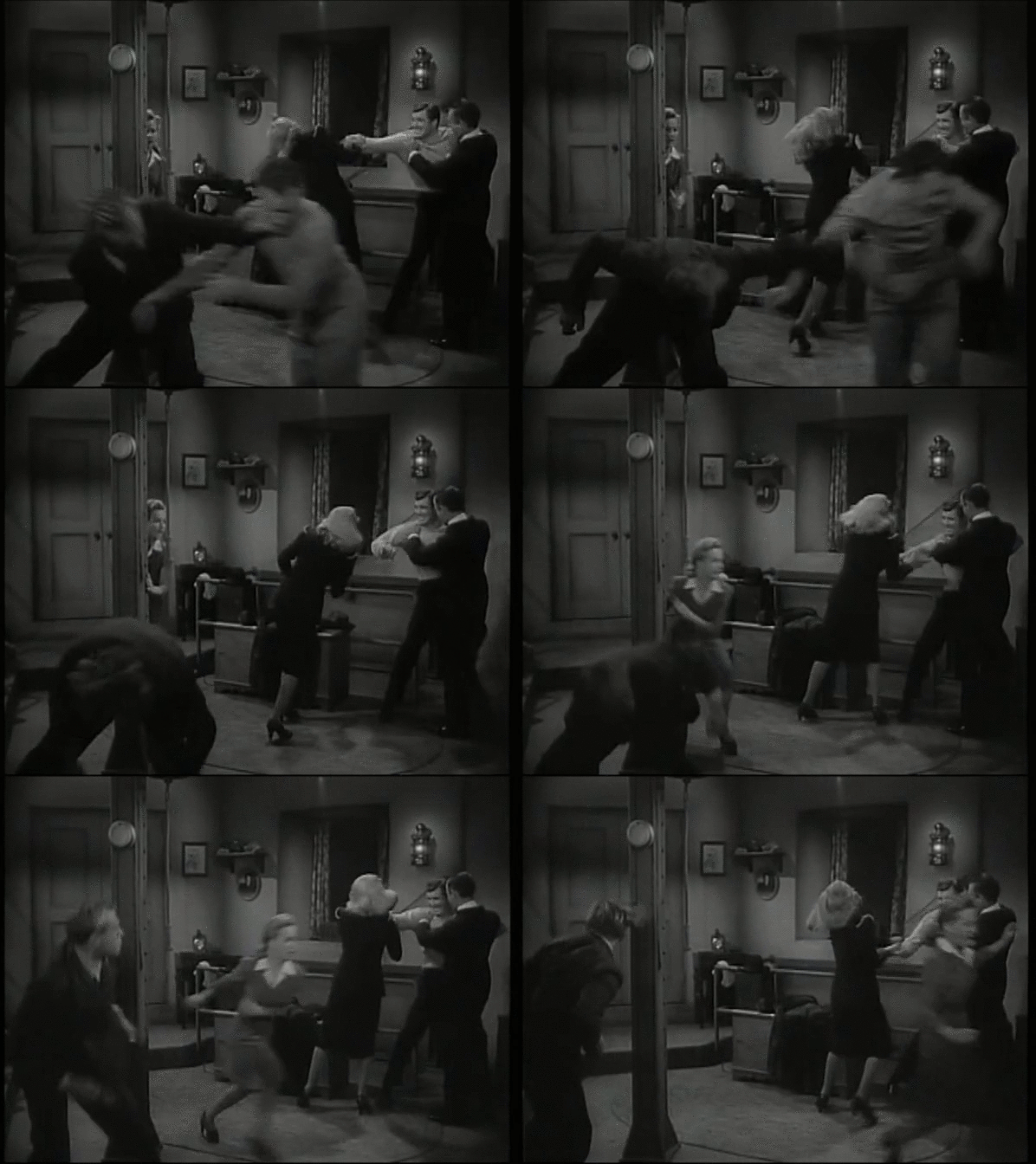
It was time for some Badly Choreographed Fighting...


... and for me to say witty things like, "Watch that first
step, Adolf! It's a lulu!"

Then it was all over. The Nazis were captured and Anne
said she'd wait for me to get out of prison. She's not
quite as cute as Jimbo, but she'll do.

And yet, it seems the last laugh goes to our Nazi friend. He
escaped, hid out in Hollywood and re-emerged in the 1960s
as the beloved Sgt. Schultz on TV's "Hogan's Heroes"!

So stay vigilant, America, and remember -- today's TV star
might become tomorrow's Nazi. Lookin' at you, Charlie Sheen! 

Awkward Early Talkie Theatre: "The Hollywood Revue of 1929"

"The Hollywood Revue of 1929," MGM's entry in the look-at-us-we're-talking sweepstakes, is a lot like Warner Bros.' "The Show of Shows," released later that year. It's a big-budget hodgepodge of skits and songs featuring almost every performer on the lot (a select few were exempt -- Al Jolson isn't in "The Show of Shows" and Greta Garbo isn't in "Hollywood Revue").

The budget is so big, the chorus ends up passing the hat.
Both films were designed to introduce audiences to the brave new world of talkie films -- the ironic thing is that early talkies, because of cumbersome cameras and sound recording equipment, were much less "free" than silent films. The setting that both studios use to showcase sound is very static -- a clearly defined stage, proscenium arch and all. ("Broadway Revue" even has a pit orchestra.)

Joan Crawford warms up for her big dance number. 
Still, this was a chance to see your favorite actors and actresses talk, dance and sing. MGM used to brag about having "more stars than there are in heaven," and at least a galaxy or two is accounted for here -- Joan Crawford, Norma Shearer, John Gilbert, Marie Dressler, Bessie Love, Anita Page, Laurel and Hardy, Buster Keaton and many others.

Like "The Show of Shows," "Hollywood Revue" prides itself on being very up to date, with sketches that poke fun at quaint Victorian songs and melodramas. The opening number of "Hollywood Revue" and at least part of the proceedings take place in the context of a much more modern setting -- a, um, minstrel show.

The emcees here are Conrad Nagel and Jack Benny. Benny was a headliner in vaudeville by this point, but this is early in his career and he's just beginning to perfect the mannerisms and low-key style that he would utilize so successfully in radio and television. The emcee of "The Show of Shows" is Frank Fay, whose stage persona Benny freely admitted to appropriating, and in comparing the two, Fay comes off as more effective (at least to me). Here's Benny in a sketch with William Haines:


Here, by comparison, is Frank Fay in "The Show of Shows":


The other emcee, Conrad Nagel, is pleasing and polished -- like almost everybody else he sings a number, a song that sends lyrics of love right up into Anita Page's nostrils.

The two performers who are featured most prominently in "Hollywood Revue," however, are singers -- Charles King and Cliff "Ukulele Ike" Edwards. King was the male lead in MGM's other big film of 1929, "The Broadway Melody," and gets far more attention here that he merits. (He sings the song "Your Mother and Mine," which is parodied in "The Show of Shows.")

Edwards, on the other hand, was never a big star, but he was a reliable second banana in several MGM films of the early 1930s. (And he was the voice of Jiminy Cricket in "Pinocchio.") His singing style is simple and appealing, and here he accompanies himself on the uke:


That is some art right there.

Comedy bits are offered by Laurel and Hardy, Buster Keaton and Marie Dressler, but they are minor stuff. There are also quite a few ensemble numbers with elaborate sets and costumes.

And then, toward the end, there is for me the most wince-able portion of "Hollywood Revue" -- a bit, shot in two-strip Technicolor, with Norma Shearer, John Gilbert and Lionel Barrymore.

You've probably heard of it if you haven't seen it -- Gilbert and Shearer perform the balcony scene from "Romeo and Juliet," and then director Barrymore tells them that, under studio orders, the dialogue must be updated.

Norma Shearer tries and fails to act like a regular person.
It's one of those ideas that has "cute" written all over it, and not in a good way. It also features what is supposed to be good-natured, natural bantering between the three, and it's truly squirm-worthy.

Soon enough comes the ending, also shot in two-strip Technicolor -- it's the movie's big hit song, "Singin' in the Rain," sung by the entire cast, in rain slickers, as they prepare to -- board Noah's Ark?


SEE Cliff Edwards in a rain hat! SEE Joan Crawford looking around for her camera! SEE Buster Keaton look like he wishes he was somewhere else!

SEE the complete credits for "The Hollywood Revue of 1929"!


"Dance, Fools, Dance" and the MGM Effect

In the early 1930s, MGM boasted that it had under contract "More Stars Than There Are in Heaven," but the movies that we think of as classically MGM -- perfectly pruned packages of gloss and glamour and very little awareness of the outside world -- really didn't come along until the mid-1930s. Of all the Hollywood studios, you get the feeling that MGM was the one place where executives -- particularly grand poobah Louis B. Mayer -- welcomed the motion picture code because its limitations on salty behavior and innuendo dovetailed so beautifully with his idealized vision of American society.

At any rate, the 1931 film "Dance, Fools, Dance" offers an early look at what we might call the MGM effect, as demonstrated by the character played by and the performance given by the heroine, Joan Crawford. At this point, Crawford and Norma Shearer were the co-queens of the MGM lot.

"Dance, Fools, Dance" opens on a yacht. We can tell this is an MGM film as opposed to, say, Warner Bros., because the yacht isn't owned by bootleggers. It's owned by Crawford's wealthy father, and she's on board with her hunky boyfriend, uttering devil-may-care lines like "I believe in -- trying love out." Also on board is a party of carefree, wealthy young people. Because this is a pre-code film, Crawford has a risque suggestion -- let's go swimming in our underwear -- and we see it happen:


Crawford's father is forgiving of his daughter's antics, but he's also grumbling about the volatility of the market, and sure enough, within a scene or two, his big stock crashes, and so does dad. He's cashed in his chips and lies flat on the floor of the stock exchange.

Amazingly, given the number of financial whizzes he must have known, father had no life insurance, so Bonnie (Crawford) and ne'er-do-well brother Rodney (William Bakewell) are flat busted. What to do?

Bonnie: You [could] do what a great many others have done in those circumstances -- go to work.

Rodney: Work? Hah!

Bob (Lester Vail), Bonnie's boyfriend from the yacht, the swimmer in his BVDs, comes by and Bonnie hopes he'll sweep her away into wealthy wedlock. But he just makes noises about marriage being "the right thing to do" and love doesn't seem to be involved, so she lets him off the hook. Then she has to stand by and overhear her former friends make fun of her as the furniture is being auctioned off.    

So Bonnie goes out and gets a newspaper job, where her seatmate is Cliff "Ukulele Ike" Edwards, later the voice of Jiminy Cricket. And brother Rodney goes out and gets a job, too, for bootlegger Jake Luva (Clark Gable, fresh off playing a bootlegger opposite Norma Shearer in "A Free Soul").

It doesn't take long before Rodney "Work? Hah!" Jordan is in over his head. He gets mixed up in a shootout and is warned not to talk. Meanwhile, over at the newspaper, Bonnie is unaware her brother is involved and uses strange facial expressions to convey her interest in covering the story:


Rodney blabs about the shootout to Edwards, who has gone to sniff out the story. The bad guys know Edwards knows, so they shadow him as he heads back to the paper, and Rodney is given an unpleasant assignment:


Crawford then goes undercover at the speakeasy to find out what happened to Edwards, still not knowing her brother was involved. Naturally, she becomes the lead dancer in the floor show, and attracts the attention of Gable. He delivers that never-fail pickup line: "You got me goin', sister."

They go to Gable's apartment, where she picks up a ringing phone and discovers that her brother is on the line, wanting to talk to Gable.

She does not handle it well:


Clearly, Crawford's character is not cut out for undercover work, and that's another way that "Dance, Fools, Dance" demonstrates the MGM effect. The movie is built around its star, and Crawford never misses a chance to break down dramatically over anything that happens.

In the final showdown, brother Rodney and bad guy Gable gun each other down and again, it's all about Crawford. She has dipped her toe into the underworld and can't wait to pull it back out. Rich boyfriend reappears and re-proposes, and she leaves the newspaper. You can't help but compare it with what would've happened in a Warner Bros. movie -- Joan Blondell or Glenda Farrell or Bette Davis would have played Crawford's role in a much more likably cynical manner. When the big reveal comes about her brother being involved with gangsters, they would've reacted, but kept it together, actually making their performance more involving and less showboat-y. And forget about the rich boyfriend -- in the Warner Bros. version, Blondell//Farrell//Davis would've ended up with the paper's handsome star reporter, undoubtedly played by George Brent.

Here's the full cast and crew for "Dance, Fools, Dance."