Showing posts with label James Cagney. Show all posts
Showing posts with label James Cagney. Show all posts
James Cagney's Final Act(ing)
After a thirty-year Hollywood career, James Cagney made what he thought would be his final film in 1961 -- a comedy directed by Billy Wilder called "One Two Three." Cagney then retired, spending his time between two farms he owned -- one on Martha's Vineyard and one in upstate New York. But Cagney got tired of being retired, and in 1980 his friend, director Milos Forman, talked Cagney into taking a small but significant role in Forman's film adaptation of the bestselling novel "Ragtime." Further encouraged by his family and lifelong friend Pat O'Brien, Cagney went on to play the lead role in a 1984 TV movie called "Terrible Joe Moran." By that point Cagney had been weakened by several strokes and was in a wheelchair, but he powered through, inspired by O'Brien's words of encouragement: "Do it, Cagney. It's medicine."
Sources:
"Cagney, 82, Is Embarrassed Anew at Being a 'Star'," Chris Chase, The New York Times, November 17, 1981
"Peter Gallagher," theavclub.com, June 14, 2011
"Ragtime," milosforman.com
"Ragtime," TCM.com
"TV Review: 'Terrible Joe Moran' Starring James Cagney," John J. O'Connor, The New York Times, March 27, 1984
"Faraway Fella: 'Cagney,' a Biography by John McCabe," David Thomson, The Los Angeles Times, January 4, 1998
Art Carney: A Biography, by Michael Seth Starr
Cagney, by John McCabe
"Cagney Felt at Home in Dutchess," Larry Hughes, Poughkeepsie Journal, June 18, 2015
"James Cagney: Looking Backward," Timothy White, Rolling Stone, February 18, 1982
"James Cagney's Condition Provokes Controversy," Sylvia Lawler, The Morning Call, March 25, 1984
Director Joseph Sargent on James Cagney, emmytvlegends.org
"Profile in Courage: Nobody Ever Said Cagney Wasn't a Fighter," Rod Townley, TV Guide, March 24, 1984
A Talk About James Cagney
I'm a fan of James Cagney. I've written about him here, here, here, here, here and here. To me he is one of a handful of movie stars with a real sense of physical style as well as acting expertise. Dan Schneider, the impresario behind the arts site Cosmoetica, graciously invited me and fellow film blogger Marilyn Ferdinand to talk about Cagney's life and career. Here it is:
CMBA Fabulous Films of the '30s Blogathon: "G-Men," or Better Fed Than Dead

Hollywood's Most Famous Bad Man Joins the "G-Men" and Halts the March of Crime! -- ad for "G-Men" in Variety, April 1935
1934 was a bad year to be a gangster.
On May 23, Bonnie and Clyde were gunned down in Louisiana.
On July 22, John Dillinger bought it outside the Biograph Theatre in Chicago.
On October 18, Charles Arthur "Pretty Boy" Floyd -- who had become Public Enemy No. 1 after the death of Dillinger -- was killed in a cornfield near Clarkson, Ohio.
And on November 17, George "Baby Face" Nelson -- who had become Public Enemy No. 1 after the death of Floyd -- was wiped out in a showdown with FBI agents just outside of Chicago.
On the other hand, 1934 was a very good year indeed to be J. Edgar Hoover.
 Hoover's genius for public relations -- and for self-promotion -- turned the tables on the "glamorous" gangsters who got all the headlines in the early 1930s. He created the idea of "Public Enemy No. 1" so that America could keep track of which gangsters were getting knocked off. He planted in the public imagination the idea that upright, incorruptible FBI agents were present at every shootout with every gangster, regardless of whether they were or not. And when George "Machine Gun" Kelly, surrounded in 1933 by FBI agents, said, "Don't shoot, G-Men!," Hoover eagerly promoted the nickname.
As a result of the headlines -- and also partly due to the desire of Hollywood studios to get on the right side of the Hays office in those days of more rigid enforcement of the Production Code -- by early 1935 gangsters were out and the Feds were in.
The first rush was to register the title "G-Men," and Warner Bros. beat Universal to the punch by just 24 hours.
Several studios had entries in the sweepstakes -- RKO's "The People's Enemy," United Artists' "Let 'Em Have It" and MGM's "Public Hero Number 1," among others.
But the winnah and champeen -- one of the highest-grossing movies of the year, in fact -- was "G-Men."
And the man playing the lead G-Man was the same guy who'd spent the last five years at Warner's shooting at cops, fighting at the drop of a fedora, doing a musical or two and pushing women around -- James Cagney.
As James "Brick" Davis, a lawyer who joins the FBI to avenge the death of a friend who was also an agent (Regis Toomey, gone in a flash), Cagney is as self-assured and as pugnacious as ever. Still, there's something muted about him -- he's tough, but he's missing that impudent edge that enlivened so many pre-code movies.
To its credit, the movie doesn't try to pass off Cagney's character as a straight arrow -- he's a street kid who got a college education courtesy of McKay, the local bootlegger (William Harrigan). But the guy expects no favors -- he wants Brick to follow his own moral compass.

It just so happens that Brick's buddy was killed by the same gang that's high on the FBI's most wanted list, a group led by Collins (Barton MacLane). But the real target is triggerman Leggett (Edward Pawley), the guy who killed Brick's pal. And nobody gets away with that, see?
In the best Warner tradition, "G-Men" rips plot elements straight from the headlines. A train station ambush that sets Leggett free is based on the Kansas City Massacre, a 1933 bloodbath that involved the efforts of Pretty Boy Floyd to free prisoner Frank Nash. And Collins and his gang end up hiding out at a Wisconsin hunting lodge -- the same kind of place as Little Bohemia, where the feds tried and failed to catch the Dillinger gang in early 1934.
Brick's old bootlegger pal McKay owns the place, but he's a victim and is being held hostage by the gang. Also there is Brick's old flame, the dvancer. Since Brick has brushed her off, she's taken up with Collins -- with deadly consequences.
You can pretty much predict how "G-Men" ends, and when Brick ends up saving McCord's life in a shootout that captures the bad guys, McCord endlessly talks about what a great guy Brick is to anyone who'll listen. The movie is a kind of canonization of Cagney the hero and kicks off the second half of his busiest and most iconic decade. If his work doesn't have quite the same spice as his earlier performances, well, let's just chalk that up to being better fed than dead.
Here's a trailer from a re-release of "G-Men" from 1949, celebrating the 25th anniversary of the FBI:
Pre-Code vs Post-Code: "Picture Snatcher" and "Escape From Crime"

And, sure enough, the 1942 film "Escape From Crime" isn't much of a movie.
Both films are based on an original story by Danny Ahearn, but "Picture Snatcher" has that cheerful pre-code let's-see-what-we-can-get-away-with spirit, personified by our hero, Danny Keene, played by James Cagney. "Picture Snatcher" is a pretty typical pre-code Cagney picture, and to me that's not bad at all -- it has spice, irreverence and a bit of a nasty

The bare bones of Ahearn's story -- paroled convict gets a job as a rough-and-tumble newspaper photographer -- is the same in both films, but "Escape From Crime" removes all the tasty vices on display in "Picture Snatcher," and the result is flavorless and forgettable.
Here Danny is played, glum and guilt-ridden, by Richard Travis. In fact, Danny, also known as Red, is so surly that Jackie Gleason, in a brief bit as the world's most hilarious convict, can't even get him to crack a smile:
(You have just seen Gleason's entire performance. He doesn't show up again.)
Post-code Danny is cranky because he hasn't heard from his wife Molly (Julie Bishop) in a long while. Yes, this Danny is married, unlike pre-code Danny. And he has a baby daughter. So when post-code Danny gets a parole from Stock Footage Penitentiary, he's on the street with not one, but three, mouths to feed. When Danny gets sprung he heads right to see Molly, and whatever disagreement they were having instantly disappears. So why give Danny an attitude at the beginning? It's not the last time that this movie won't make a lot of sense.
In "Picture Snatcher," things also begin with Danny's release from prison, but it's a much jollier affair. Danny's old gang comes to pick him up, and they brought along a couple of women to make Danny welcome. Then Danny indulges himself with a perfumed bath and coolly announces to his buddies that he's dropping out of the crime game. He ends his speech by taking the money that was owed him as part of the job he went up the river for and then strolls out. In other words, Boom.
Post-code Danny, meanwhile, is a painfully straight arrow, and he's broke. But he spent his time in stir taking mugshots, so he's learned about photography, and he appeals to newspaper editor Cornell (Frank Wilcox) for a job. Cornell is as much of a stick-in-the-mud as Danny -- Cornell's pre-code equivalent, editor "Mac" MacLean (Ralph Bellamy), is shacking up with one of the reporters (Alice White) and drinks bourbon on the job. Cornell just sits at his desk and gives the impression that his suspenders are too tight.
Anyway, post-code Danny gets turned away jobless, and as he leaves the office two things happen -- one is that he meets his old nemesis, flatfoot Biff "Biff" Malone, who sent him up; and the other is that he witnesses and photographs a bank robbery.
Compare that to the other Danny's first job, a pre-code situation if ever there was one -- a firefighter is holed up in his own burned-out apartment. His crew was called to a fire there, and the firefighter discovered his dead wife in bed with another man. Danny's job is to get an old photo of the firefighter and his wife, so he poses as an insurance man sent to survey the damage.
That incident illustrates some of the nastiness in "Picture Snatcher" -- we actually root for Cagney to take the poor guy's wedding picture.
Just as post-code Danny has Biff the cop on his tail, pre-code Danny has Det. Lt. Nolan (Robert Emmett O'Connor, who else?). To complicate matters, Danny has fallen for Nolan's daughter (Patricia Ellis), a pretty journalism student. To further complicate matters, editor Mac's squeeze has also fallen for Danny. Post-code Danny doesn't have time for the ladies -- he's got a wife and kid to take care of!
But the story's one big plot element makes it into both movies -- to save his job, Danny is forced to take an illegal photo of someone in the electric chair. When the rival reporters find out, they (and the cops) chase Danny back to the paper. Just watch how Cagney and Travis each handle the scene:
Something else to watch in those clips -- the sets. "Picture Snatcher" actually looks like it was shot in New York City, while "Escape From Crime" is pretty clearly stuck on the Warner back lot. We're supposed to be in Manhattan, but the bank holdup that Danny witnesses is at the "Doreville State Bank." Doesn't sound very cosmopolitan to me. And he and his wife are supposed to live on East 65th Street, but their house looks a bungalow, and you're about as likely to see a bungalow on the Upper East Side of New York City as you are a taxi-driving octopus.
The performances are also miles apart -- at one point, Travis walks into the family home with a "Sure and it's your husband, Mrs. O'Hara!" No. Do not attempt an Irish brogue, Richard Travis. Just don't. You are no James Cagney. You're no Jeanne Cagney, for that matter.
"Escape From Crime" does give us plenty of gunplay, and why not? Violence is fine in a post-code movie; sex, not so much. But the movie's real failing is that, unlike "Picture Snatcher," the makers forget a simple fact -- a great journalist can, and maybe even should, have a slightly larcenous side.
Pre-Code vs Post-Code: "The Crowd Roars" and "Indianapolis Speedway"
Pre-code versus post-code is the difference between a Duesenberg and a Hummer, between cafe au lait and chocolate milk, between a camisole and a union suit.
Take the differences, for instance, between the 1932 film "The Crowd Roars" and the 1939 film "Indianapolis Speedway." Same story (by Howard Hawks, who also directed the first film), same setting, same characters (with different names, in some cases), even much of the same racetrack footage. By the way, want to know how to switch up your stock footage of a crowd? Just flip the image, like this:


And, since these are Warner Bros. films made in the 1930s, naturally both of them feature Frank McHugh -- playing the same character, and even with the same name. Spud. (Frank McHugh was born to play guys named Spud.)
But there's a distinct difference in the way the film's romantic relationships are portrayed, and, by extension, in the relationship between the brothers at the center of the story.
The brothers are Joe and Eddie Greer, played by James Cagney and Eric Linden in "The Crowd Roars" and Pat O'Brien and John Payne in "Indianapolis Speedway." Joe is a world-famous racing driver who drinks and carouses a little too much, tilting slightly but not totally into arrogance. Eddie is his hero-worshiping brother, who also wants to race.
 In the 1939 version, Joe's reluctance to work with Eddie has a noble basis -- he wants Eddie to finish college, at Joe's expense. But after Joe leaves his hometown and his visit with Eddie to return to Los Angeles, he finds an unexpected stowaway.
In the 1932 version, Joe's reluctant to work with Eddie for two reasons -- one is because of Eddie's inexperience, but the other is that Joe doesn't want Eddie to know that he's shacking up with longtime frail Lee (Ann Dvorak). Once Eddie enters Joe's life, Joe starts giving the cold shoulder to the bewildered Lee. In "Indianapolis Speedway," by contrast, Joe and Lee (Gale Page) are already engaged, which makes their coupling a little more legitimate. When Joe gives Lee the brushoff in "Indianapolis," he makes it clear it's because he wants to tutor Eddie. In "The Crowd Roars," Lee grins and bears it, but in "Indianapolis Speedway" she gets rightfully honked off. Here are the two scenes:
But the real woman trouble in both movies comes from Lee's friend. In "The Crowd Roars," her name is Ann (Joan Blondell) and in "Indianapolis Speedway" her name is Frankie (Ann Sheridan). In both movies, she's first portrayed as bad news, and Joe doesn't want her "corrupting" his pure younger brother. In "The Crowd Roars," when Ann meets Eddie and starts showing some leg, Joe sneers, "Why don't you stand on your head while you're at it?" -- a line that's as likely to show up in "Indianapolis Speedway" as I am to grow a tail. In "Indianapolis Speedway," Frankie -- who's the roommate of Ann -- is known for feminine wiles that have driven at least one racer track wacky. (Sheridan, at the peak of her reign as Warner's "Oomph Girl," is top billed here -- and like Blondell, she is shown in the skimpiest post-code outfits possible.)
Here's how Cagney and O'Brien handle the problem of the other woman:
Even by Cagney standards, the character of Joe is wound unusually tight. His obsession with keeping Eddie from sinful entanglements and what he perceives as loose women -- playing around for me, but not for thee -- goes beyond brotherly concern and makes him seem like a hypocrite.
O'Brien portrays Joe as a little wearier -- the movie is telling us that what he needs is to settle down with a good woman, but it'll take him about 65 minutes to figure that out.
All around, in fact, the Joe in "Indianapolis Speedway" seems more human and more vulnerable. The relationship between the brothers is much warmer -- in the 1932 film, Joe dominates Eddie the way that Cagney naturally dominates the more diffident Linden. Payne, by contrast, has a stronger screen presence and makes more of an impression opposite O'Brien.
In both versions, Joe's downfall comes when, out of anger at Eddie's romance, he causes a fiery crash that kills Spud (Twice!). Joe is spooked and can't bring himself to race again, but he gravitates toward Indianapolis on the day of the 500. Eddie is racing, and when he is injured, Joe jumps back behind the wheel with Eddie as his co-driver. Guess who wins?
 In the 1932 film, the reunion between the brothers isn't even played out -- Joe just jumps in the car and takes off. But in the 1939 version, there's a spoken rapprochement between the brothers, capped off when Eddie gives Joe his trademark cigar to chomp on for good luck. Guess who wins?
Here are the full credits for "The Crowd Roars" (which also features several real-life drivers as themselves) and "Indianapolis Speedway."
Take the differences, for instance, between the 1932 film "The Crowd Roars" and the 1939 film "Indianapolis Speedway." Same story (by Howard Hawks, who also directed the first film), same setting, same characters (with different names, in some cases), even much of the same racetrack footage. By the way, want to know how to switch up your stock footage of a crowd? Just flip the image, like this:
And, since these are Warner Bros. films made in the 1930s, naturally both of them feature Frank McHugh -- playing the same character, and even with the same name. Spud. (Frank McHugh was born to play guys named Spud.)
But there's a distinct difference in the way the film's romantic relationships are portrayed, and, by extension, in the relationship between the brothers at the center of the story.
The brothers are Joe and Eddie Greer, played by James Cagney and Eric Linden in "The Crowd Roars" and Pat O'Brien and John Payne in "Indianapolis Speedway." Joe is a world-famous racing driver who drinks and carouses a little too much, tilting slightly but not totally into arrogance. Eddie is his hero-worshiping brother, who also wants to race.
In the 1932 version, Joe's reluctant to work with Eddie for two reasons -- one is because of Eddie's inexperience, but the other is that Joe doesn't want Eddie to know that he's shacking up with longtime frail Lee (Ann Dvorak). Once Eddie enters Joe's life, Joe starts giving the cold shoulder to the bewildered Lee. In "Indianapolis Speedway," by contrast, Joe and Lee (Gale Page) are already engaged, which makes their coupling a little more legitimate. When Joe gives Lee the brushoff in "Indianapolis," he makes it clear it's because he wants to tutor Eddie. In "The Crowd Roars," Lee grins and bears it, but in "Indianapolis Speedway" she gets rightfully honked off. Here are the two scenes:
But the real woman trouble in both movies comes from Lee's friend. In "The Crowd Roars," her name is Ann (Joan Blondell) and in "Indianapolis Speedway" her name is Frankie (Ann Sheridan). In both movies, she's first portrayed as bad news, and Joe doesn't want her "corrupting" his pure younger brother. In "The Crowd Roars," when Ann meets Eddie and starts showing some leg, Joe sneers, "Why don't you stand on your head while you're at it?" -- a line that's as likely to show up in "Indianapolis Speedway" as I am to grow a tail. In "Indianapolis Speedway," Frankie -- who's the roommate of Ann -- is known for feminine wiles that have driven at least one racer track wacky. (Sheridan, at the peak of her reign as Warner's "Oomph Girl," is top billed here -- and like Blondell, she is shown in the skimpiest post-code outfits possible.)
Here's how Cagney and O'Brien handle the problem of the other woman:
Even by Cagney standards, the character of Joe is wound unusually tight. His obsession with keeping Eddie from sinful entanglements and what he perceives as loose women -- playing around for me, but not for thee -- goes beyond brotherly concern and makes him seem like a hypocrite.
O'Brien portrays Joe as a little wearier -- the movie is telling us that what he needs is to settle down with a good woman, but it'll take him about 65 minutes to figure that out.
All around, in fact, the Joe in "Indianapolis Speedway" seems more human and more vulnerable. The relationship between the brothers is much warmer -- in the 1932 film, Joe dominates Eddie the way that Cagney naturally dominates the more diffident Linden. Payne, by contrast, has a stronger screen presence and makes more of an impression opposite O'Brien.
In both versions, Joe's downfall comes when, out of anger at Eddie's romance, he causes a fiery crash that kills Spud (Twice!). Joe is spooked and can't bring himself to race again, but he gravitates toward Indianapolis on the day of the 500. Eddie is racing, and when he is injured, Joe jumps back behind the wheel with Eddie as his co-driver. Guess who wins?
Here are the full credits for "The Crowd Roars" (which also features several real-life drivers as themselves) and "Indianapolis Speedway."
My CMBA Fabulous Films of the '50s Blogathon Entry: "Love Me or Leave Me," or Great Day
This post is part of the Fabulous Films of the '50s Blogathon, brought to you in living color by America's premier classic movie blog association, the Classic Movie Blog Association.
 The 1955 film "Love Me or Leave Me" comes smack dab in the middle of Doris Day's peak performing decade -- at its beginning she was a game gamine in routine Warner Bros. musicals and by its end she would be, arguably, the biggest and most bankable female star in Hollywood.
But "Love Me or Leave Me" is much more than a marker -- to me, it's one of Day's best movies, and certainly the one where she first demonstrates her chops as a top-flight dramatic actress. She's so good, in fact, she's on a level with her co-star James Cagney -- and that's quite a level. Day might have spent the first part of the 1950s in fluff like "Tea for Two," "Lullaby of Broadway" and "Shine On, Harvest Moon," but she was learning her stuff, and in this movie she struts it like she never did before.
We are in 1920s Chicago, the city of the big overcoats. At one of the burg's lesser nightspots, the Dance-Like-No-One-Is-Watching Hall, Ruth Etting (Day) is making with the foxtrot and Charleston, spending her evenings being pawed by pathetic prancers. When she talks back to a fresh customer, she gets the boot -- but she has lassoed the attention of Moe "the Gimp" Snyder (Cagney), a small-time hood.
At first, Snyder is solely interested in Ruth because he likes the way the fringe swings on her dress, and he thinks of her as a quick pickup. But she quickly lets him know just what kind of girl she is, and he can like it or lump it:
He likes it.
So Snyder takes Ruth under his wing, although his motives aren't totally altruistic. He uses his influence to get Ruth another job, at a club that we'll call Chez Cockroach. She joins as a member of the dancing line, but she wants to sing. Snyder's eyes are on the prize, so he does anything Ruth asks him, and she gets a spot as a singer. On her opening night he's a bundle of nerves:
From there it's only a short jump to radio, records and the Ziegfeld Follies, all with Snyder calling the shots. If Ruth strains too hard at the leash, he yanks it to remind her who's boss and who helped her get to the top. And she goes along with it, figuring she has an obligation to Snyder.
But Snyder wants more than to be Ruth's manager -- he wants Ruth. And in the movie's saddest scene -- both because of Ruth's despair and because of Snyder's desperation to convince Ruth to love him -- they get married. Snyder's tries to cheer Ruth by reminding her of how he can guide her career, and her response is devastating: "You don't have to work so hard -- you don't have to sell me. I'm sold."
After playing nightclubs around the country -- and becoming an expert at drinking heavily -- Ruth ends up in Hollywood, where she once again meets Johnny (Cameron Mitchell), a pianist who helped guide her career in Chicago. Now he's the musical director on Ruth's picture, and although she loves him she knows that Snyder will kill him if he finds out, so she plays it close to the vest. Still, that doesn't keep Snyder from resorting to violence out of jealousy.
"Love Me or Leave Me" is based on a true story, but it's been cleaned up for Hollywood in several ways. For one, Day is, from all accounts, a much better all-around performer than Etting ever was. Etting's strength was singing and that was it -- during her appearances in the Ziegfeld Follies, she was instructed to exit the stage after her number so as not to interfere with the dancers. For another, the movie's Snyder was meaner and poorer in real life -- he drained Etting financially as well as emotionally.
Etting herself is said to have disliked Day's performance, expressing a preference for Jane Powell in the role. She thought Day was too tough -- to me, Day underplays the role perfectly. She's cool, but with an edge. And a movie with a female lead who didn't hold her own against Cagney would be painful to watch.
Cagney was nominated for a Best Actor Oscar for "Love Me or Leave Me," but Day wasn't. Doesn't seem fair -- but in typical Day fashion, she sucked up any disappointment she might have felt and in 1956 she demonstrated her dramatic skills again in Alfred Hitchcock's "The Man Who Knew Too Much." You go, girl.
The "Public Enemy" Guide to Life
I think we can all agree that some movies offer great life lessons that we can tuck into our memory banks and carry with us, like loose change in our pockets or maybe lint, as we traverse through this unpredictable and awesome thing called life. I have found, for example, that the 1931 film "The Public Enemy" is stuffed like crazy with wisdom, and I can say without fear of contradiction that everything I need to know I learned from ... well, see for yourself.
 |
| Get regular exercise. |
 |
| No spanking unless its consensual. |
 |
| Be open to surprises. |
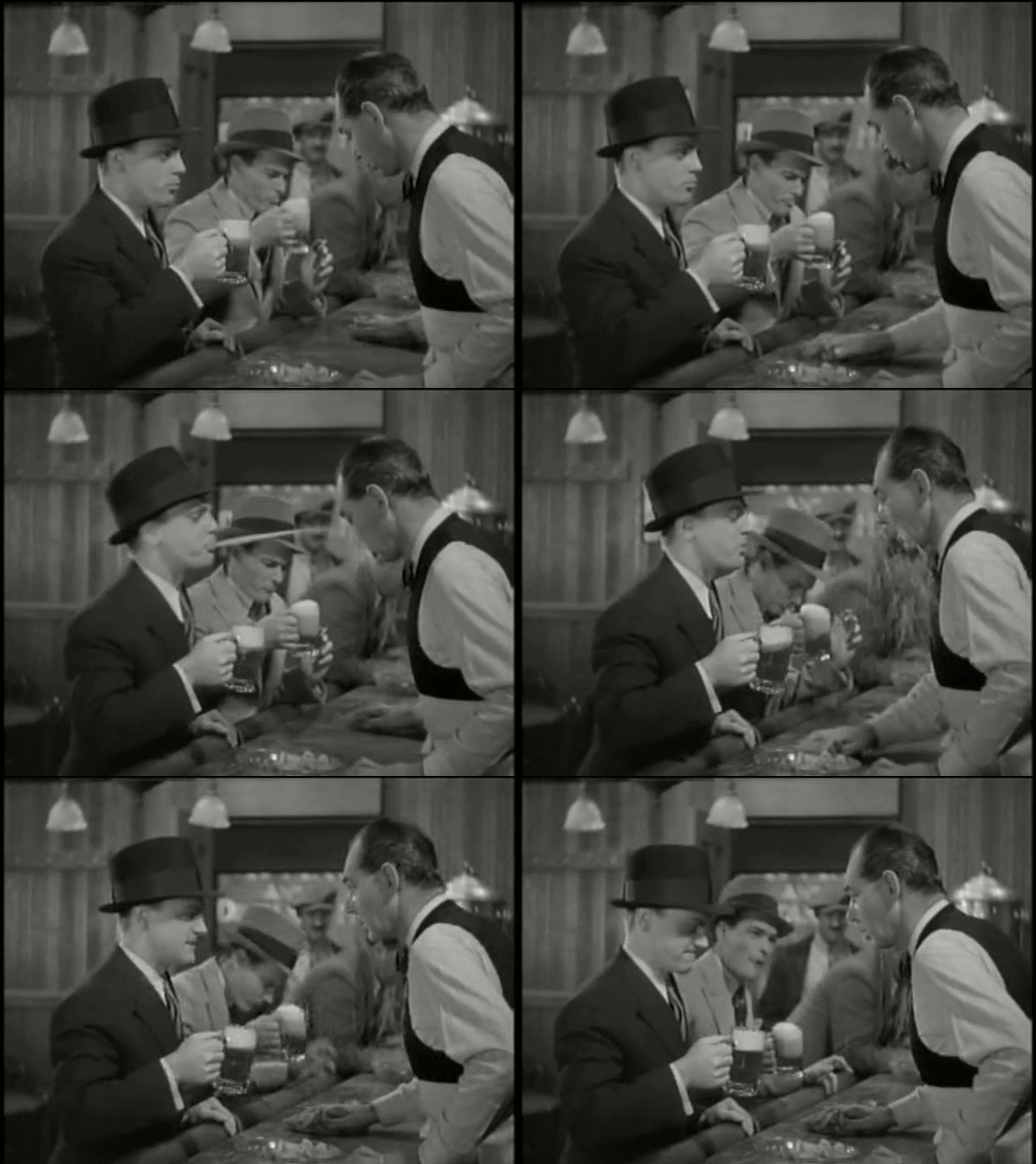 |
| Be respectful. |
 |
| Encourage your loved ones to make healthy food choices. |
 |
| Cultivate an appreciation for music. |
 |
| Again -- no spanking unless it's consensual. |
 |
| Be kind to your mother. |
 |
| And finally -- always celebrate Halloween. |
"Footlight Parade," or Taps
 |
| Everything below this logo is made up. |
INTEROFFICE MEMO
April 12, 1933FROM: Busby Berkeley
TO: Jack Warner
Greetings, J.L.
First off, let me say I was delighted to see you at the premiere of "Gold Diggers of 1933" the other night along with your new protege, Miss LaTour. I think her studio dancing lessons are paying off -- she seemed very flexible. And then she did that high kick that knocked off Jolson's toupee when he was looking up her skirt! I thought May Robson was going to bust a gut laughing.
Second, many thanks for the gift of the spats. I can't think of a better way to mark the success of "42nd Street" except maybe a large bonus, ha ha!
Now to the point of this memo -- an update on our next musical project.
I know we have a title picked out -- "Step-Ins of 1934" -- and we have James Cagney set as our lead. I have a story sketched out that I'd like to tell you.
I have an idea that Cagney, basically, plays me in this picture -- he is a brilliant creator-choreographer of motion picture prologues. And he is a prisoner of his own success, something I -- if you will excuse a personal aside -- know a little something about.
Every time Cagney comes up with a brilliant musical number filled with drama, spicy humor, scantily dressed girls and dazzling geometric dance routines -- something that takes weeks to choreograph, costume, set up and shoot -- he gets but one response from his bosses:
"Whaddya gonna do next?"
 It's enough to drive a person to drink! (Speaking of drinking, J.L., thanks for having a "talk" to the judge about that whole messy car wreck incident.)
So Cagney is the brains of the outfit, and he works for two oafish producers -- let's say Guy Kibbee and Arthur Hohl. They are lazy, leeching slobs who wouldn't know Art if they tripped over it. They contribute nothing of value, but they are content to ride on the back of Cagney's success. His creations make thousands for the company and yet he is rewarded with something puny and insignificant, like a lousy pair of spats.


And speaking of Cagney, I think he will be swell in this picture. He has a natural pugnacious grace that fits the character perfectly and a background in dance. I know he will be happy to step away from gangster roles temporarily -- he and I have had many heart-to-heart talks about what it's like to be taken for granted by oafish producers who make millions while the performer gives his all and guarantees the success of a picture much more than anything contributed by the overpaid, empty suits in the front office.
But I digress.

 And before you ask me "whaddya got," I can tell you that the musical numbers will be sensational, J.L. These are, of course, the numbers Cagney's character slaves over while everyone else in the business is busy counting the money he makes for them.
And, of course, they will all feature Keeler. One will be called "By a Waterfall," featuring dozens of young woman in flesh-colored bathing suits, with strings of green vines as thongs.


Finally, just one more thought. While I recognize the box-office value of a title like "Step-Ins of 1934," I also know that the general feeling in Hollywood these days is that the Production Code we've been flouting for so long is about to get some teeth. So rather than ask for trouble, I've been thinking of another, less incendiary title. What do you think of "Footlight Parade"? Chew it over like one of those big expensive cigars you always have in your mouth and see what you think.
As for me, I'm convinced that, by any title, this movie is going to be a hit. How big a hit? Let's just say I look forward to getting a new pair of spats.
Best,
Bus
The Polly Walters Film Festival: "Young Bride" and "American Madness"
 |
| Polly Walters and Joan Blondell in "Bleaches" |
Of all the actors and actresses who appeared in 1930s movies, Polly Walters (1913-1994) was certainly one of them.
Although she appeared in small roles in only a handful of movies between 1931-32, Walters made an impression with her blonde hair, deadpan style and Betty Boop-ish, singsong voice. She was usually a working-class girl -- a waitress, a hotel maid, a manicurist, a switchboard operator -- with a working-class name like Mabel, Ethel, Daisy or Gladys.
Born Maude Walters in Zanesville, Ohio, our heroine trained as a dancer and made her way to Broadway, appearing in several productions during the late 1920s. Then came a stage stint as Eddie Cantor's straightwoman before Warner Bros. signed her to a contract in 1931.
At Warner's, Walters appeared in three James Cagney films -- "Taxi," "Smart Money" and "Blonde Crazy." In "Blonde Crazy," she plays a hotel maid who warns another maid -- the film's female lead, Joan Blondell -- to stay away from Cagney, as a bellhop who knows all the angles:
Walters also appeared in Warner films with Douglas Fairbanks Jr. ("Union Depot"), Loretta Young ("Play-Girl"), Edward G. Robinson ("Five Star Final") and Warren William ("The Mouthpiece" and "Beauty and the Boss").
For the most part, her Warner roles were bits. It wasn't until she was lent out to other studios that Walters played roles that were actually important to the plot.
In the 1932 RKO film "Young Bride," for instance, she is Daisy, the streetwise best friend of innocent heroine Allie (Helen Twelvetrees). They work together as librarians, and Daisy introduces Allie to nogoodnik Charlie (Eric Linden). Allie ends up marrying Charlie while Daisy ends up with Pete (Cliff "Ukelele Ike" Edwards), and doing lots of heavy partying:
Then in one of her last films, Frank Capra's "American Madness," released by Columbia the same year, Walters's switchboard operator character starts the gossip that threatens to bring down a bank headed by honest Thomas Dickson (Walter Huston):
After appearances in only 17 films, Walters left Hollywood in 1933 and went back to Broadway, appearing in a production called "She Loves Me Not" with Burgess Meredith. After that, there was talk of returning to Hollywood, but nothing materialized. From 1936-37 Walters was on stage in "Red, Hot and Blue" with Jimmy Durante, Ethel Merman and a young Bob Hope. Then came roles in plays that ran only a few performances -- her last work was in a 1942 production called "The Life of Reilly" that closed quickly.
For the next 50-odd years, Walters lived a quiet life in New York City -- she had no other film, play or TV credits. Maybe she found a job as a switchboard operator.
"City for Conquest" Starring James Cagney and ... Jack Benny?

In a way, "City for Conquest" is the last Cagney picture of that type. It's an elegy for those movies, usually set in New York City, with Cagney as a working-class Irishman named Danny, Eddie or Tommy who fights passionately for what he believes in, regardless of what side of the legal fence he's on.

We begin in the city's Lower East Side, of course, led there by a philosophical and slightly annoying tramp (Frank Craven) who's supposed to symbolize the unbreakable spirit of New York. This part would seem a natural for Craven, who played a similar role, the omniscient stage manager, in the Broadway production of "Our Town." It isn't that it's a bad performance -- it's just that the character is more of a dramatic conceit than a person, and Craven has to make his way through purple pronouncements about the city like this: "Look at it! Seven million people fighting, fighting, clawing away to get one foot on a ladder that'll take em to a penthouse." See for yourself:
We first see Danny (Cagney) and Peggy (Sheridan) as kids -- Peggy demonstrates her love of dancing by doing a number on the sidewalk, and Danny demonstrates his gift for fighting by decking a kid who interrupts her act. Oh, and there's one other kid hanging around -- Danny's artistic brother Eddie (Arthur Kennedy), fingering his accordion and staring into space, dreaming of the symphony he's going to compose.
Then we fast forward a few years -- Danny is driving a dump truck and boxing for relaxation. Eddie is giving piano lessons and still dreaming of that symphony, which he describes in phrases that might as well be spoken by our verbose tramp friend: "It's the city, with all of its proud, passionate beauty and all of its sordid ugliness ... of its teeming seven millions and its barren loneliness."
Meanwhile, Peggy's dream of dancing is given life by the smooth, arrogant Murray (Anthony Quinn in his days as the second-string Cesar Romero), and they become a team. Danny's happy for her success -- she's always gonna be his goil, no matter what -- but when Murray starts bad-mouthing Peggy and her friends, Danny gets hot:
Despite his skill in the ring, and despite the entreaties of his buddy Mutt (longtime Cagney sidekick Frank McHugh) Danny's always been resistant to a boxing career. Then, when Eddie loses his music scholarship and Peggy tells him of her dreams of being upwardly mobile, Danny realizes he's going to need some extra kale. So he signs with kindhearted fight promoter Scotty MacPherson (Donald Crisp) and starts making the boxing circuit at the same time that Murray and Peggy start making the vaudeville circuit. We learn this in one of those great Warner montages:
About this time, we're introduced to a character who's a lot like the characters Cagney used to play -- Oogie, a pal from the old neighborhood (director Elia Kazan in an early role). Oogie's back from a stretch in the pen, and Danny stakes him to a meal and a new pair of shoes. As Danny rises in the fight game, Oogie's star is rising, too, most likely through nefarious means.
Then comes heartbreak -- Peggy leaves Danny for a nightclub tour, and a heartbroken Danny starts fighting outside his class out of anger and spite. This leads to a championship match where the opponent plays dirty by rubbing rosin dust in Danny's eyes, causing him to lose his sight. For the rest of the movie Cagney plays his role with a squint -- and he's one of the few guys who can make a squint look heroic. Oogie takes it upon himself to avenge Danny, and ends up eating lead on the waterfront. You can almost hear him say "I ain't so tough" a la Cagney in "The Public Enemy."
At the movie's climax, only Eddie has achieved his dream -- to conduct his symphony at Carnegie Hall. Danny listens on the radio, from his newsstand in Times Square:
You might call this ending over the top -- I would, but I think it's bad form to poke fun at a scene that brings tears to your eyes.

This is during the period when Benny's show, written by Bill Morrow and Ed Beloin, hadn't quite fallen into its postwar sitcom phase -- there is an opening about Jack putting his footprints at Grauman's Chinese Theatre, with Benny exhibiting the same kind of false modesty as Anne Hathaway accepting a Golden Globe for "Les Miserables."
The "City for Conquest" sketch is short, concentrating mainly on the boxer plot. Targets include the film's overblown "poetry" and Eddie's musical aspirations (Phil Harris plays Eddie, who is composing his symphony on a drum set instead of a piano. His solution for the big finish: more cowbell.) There's also fun poked at Cagney's Lower East Side patois:
Benny (as Cagney, to Mary): Is that a new skoit?
Mary (as Sheridan): Yeah. Is that a new shoit?
Benny: Yes, it's a new shoit. How do you like my shoit?
Mary: It's a little short around Detroit.
Here are the credits for "City for Conquest," and a trailer:
The Noel Francis Film Festival: "Bachelor Apartment" and "Smart Woman"

 |
| Noel |
In Hollywood, she made over 40 movies, most of them during the pre-code period, so she usually played mistresses and prostitutes, potential mistresses and prostitutes, or former mistresses and prostitutes.

Her best-known film credit is probably 1932's "I Am a Fugitive from a Chain Gang." She plays a prostitute who James Allen (Paul Muni) meets after his first escape from the gang. Her appearance is brief, but memorable:

Francis was rarely the female lead; she usually received fifth or sixth billing. In the 1931 film "Bachelor Apartment," for example, she is one of several women who are seduced by the film's hero, Lowell Sherman, who also directed. Sherman plays Wayne Carter, a bachelor whose apartment is just busting with women -- the movie is like a pre-code "Boeing Boeing." When the taxi Francis's character is riding in gets involved in an accident, Sherman -- who has been eyeing her from his limousine -- sweeps in and scoops her up:
Once Sherman gets Francis back to his bachelor apartment, he "accidentally" spills a drink on her dress, forcing her to change into something more comfortable:
Sherman has an impish comic quality and he's always fun to watch -- he also played the dipsomaniac director who discovers Constance Bennett in "What Price Hollywood?" -- and the film's storyline has him leaving girls like Francis behind so he can marry his proper stenographer, played by Irene Dunne.

Astor also tries to make her husband jealous by implying that she's been having an affair of her own with the kind Sir Guy (John Halliday), a British millionaire she met on the cruise back from Paris. But when Peggy learns of Sir Guy's fortune, she sets her cap for him:
It's too easy to blame the decline in Francis's career on the advent of the Production Code in 1935, but it's true that under the Code, parts like the ones Francis played were frowned upon. At any rate, by the mid-1930s, her career had declined to the point that she was appearing in quickie Buck Jones westerns and her final feature was 1937's "Left-Handed Law."
Here are the full credits for "Bachelor Apartment" and "Smart Woman."
"Picture Snatcher," or Cagney and Racy
Whenever I talk about my love for old James Cagney movies, my kids remind me of this clip from "Family Guy":
 To them, those movies are little more than that -- people in out-of-style clothes speedtalking to each other. To me, they're fast-moving star vehicles with a streetwise style, sharp wit, just the right amount of cheerful cynicism and the strong presence of a pugnacious star with great physical style. Actually, in the 1930s, James Cagney was more than a star. His films ended up symbolizing the style of the Warner Bros. studio -- tough, unpretentious, good-naturedly brash.
The 1933 film "Picture Snatcher" combines two staples of the studio -- the gangster picture and the newspaper picture. (Actually, at Warner's there wasn't much difference between the two.) Cagney plays Danny Kean, who's just been released from Sing Sing. His old gang, led by Jerry (Ralf Harolde), is ready to welcome him back to the criminal fold, but Danny has other ideas. This is revealed when Danny's being measured for a new suit, and he tells the tailor not to leave room for the shoulder holster. Tailor: "You're gonna be the best-dressed goniff (Yiddish for thief) in America."
No, Danny is going to go legit -- or at least legit enough to be a newspaper man. So he pays a call on editor McLean (Ralph Bellamy) at the Graphic-News, the sleaziest rag in town. McLean met Danny while he was in stir and told Danny to look him up, but he's reluctant to hire him because of his lack of experience.
Danny's chance comes as a result of a pre-code situation if ever there was one -- a firefighter ended up being called to a fire at his own apartment. He arrived to find his wife there, dead, in bed with another man. Danny's mission is to get past the fireman, who won't let any reporters into the apartment, and find a photo of the dead wife:
He's hired.
Danny then meets met Patricia (Patricia Ellis), a journalism student who's taking a tour of the newspaper. She likes him, but her dad (Robert Emmett O'Connor, forever playing a cop) is the flatfoot who put Danny behind bars. So they see each other on the sly. Meanwhile, another reporter, Allison (Alice White), also has eyes for Danny -- she even invites him to her apartment to play, um, ping pong. But she's also McLean's girl, and Danny is loyal to the guy who hired him.
Danny's next assignment is based on a real-life newspaper story -- in 1928, photographer Tom Howard, working for the New York Daily News, snapped photos of Ruth Snyder in the electric chair. Patricia's dad helps Danny get into an execution, where he does the same thing, in a scene that has echoes of "The Green Mile":
The cops and rival reporters find out what Danny did, and they give chase. He hightails it back to the newsroom:
Because of his death house escapade, Danny is in dutch with daddy, but he fixes that one by infiltrating his old gang, getting some great photos during a shootout, and then arranging it so that Patricia's father gets the credit for capturing Jerry. McLean goes to speak to Patricia on Danny's behalf while Allison pops up again:
The movie ends with a topical reference -- "Vas you dere, Sharlie" was the trademark phrase of radio comic Jack Pearl, at the peak of his popularity in 1933 as Baron Munchausen.
Here is the trailer for "Picture Snatcher," and the full cast listing.
My Old Movie Manifesto, or It Happened One Night (at My Uncle's House While I Was Watching Old Gangster Movies)
Now that I have written more than 50 posts, this seems like a good time to stop and explain why I love movies -- especially older movies, and particularly those from the 1929-35 era. And since this is a blog where one picture (or one movie scene) speaks more than a thousand words, here's my lede:
That is a scene from the 1931 film "Blonde Crazy," with James Cagney and Joan Blondell, and it contains everything I love about old movies, particularly the ones made before the 1934 production code. It's racy, it's funny, it's cynical and it's just one scene out of one movie in a year when studios cranked them out at a furious pace, at practically dozens a week. Even though there were nominal limits in place, pre-code movies reflected depression life in a particularly vivid way. They contained rough edges, adult desires and plot shadings that were later sanded down, cleaned up and bleached out by the Hollywood studio system.
The early 1930s was a time of larger-than-life movie heroes and anti-heroes like Cagney, Spencer Tracy, Edward G. Robinson, Paul Muni, Dick Powell, Robert Montgomery and Clark Gable. It was also a time of movie beauties both ethereal and down to earth, from Greta Garbo to Carole Lombard, from Marlene Dietrich to Joan Blondell.
And we cannot forget the character actors and the comics -- Aline MacMahon, Frank McHugh, Frank Morgan, the Marx Brothers, Wheeler and Woolsey, Boris Karloff and Laurel and Hardy, to name a few.
Maybe they weren't more magnetic than today's stars, but they sure as heck were more visible -- movies were the television of the early 1930s, and folks went to the show, as it was often called, at least once a week, so films were cranked out like Model Ts. (It helped that the studios owned the theatres.) And for at least the first half of the decade, these movies were edgier, sassier and more topical than they would be by the end. I personally think that, even though we came close, there are two major reasons why the United States didn't become a fascist state during the Great Depression -- Hollywood movies and Franklin D. Roosevelt. (I sound like Jack Warner, who was a big FDR booster.)
Anyway, watching these movies to me is like re-reading a favorite book, or, um, re-watching a favorite movie. I marvel all over again at the raw storytelling power of "I Am a Fugitive From a Chain Gang," or the wit of the Marx Brothers. I love watching and listening to James Cagney, with his rat-a-tat style of speaking and his exuberant-yet-contained physical presence, and Barbara Stanwyck's pugnacious performances. And to me "It Happened One Night" is one of the best pure romantic comedies ever -- and, judging by the romantic comedies we see today, contemporary Hollywood agrees, because they keep remaking it. It's also fascinating to me to watch as the industry emerges from the silent era and starts learning how to make talking movies. And it's interesting to see tropes in the making that are commonly accepted assumptions in today's films.
I also love older movies because they are free of the hype or the fashion of the moment. The years have either added or subtracted from their reputation. The older I get, the more I believe in perspective, and I think that in many cases it takes years or even decades to see a movie for what it really is -- and as I grow older, I see these movies through a different lens.
I'm not a believer that older automatically equals better, but when I watch older movies I'm more likely to forgive clumsy performances or technical snafus and marvel over the ones that still resonate and entertain, sometimes even despite those limitations. Some might argue that it's because these older movies echo my older, clumsier self. Maybe. But I also felt that way when I was 12, and first started developing an appreciation for old movies by seeing Warner Bros. gangster movies on TV at my uncle's house. (My mom wouldn't even let us watch "Dragnet.")
In this blog, my intent is to watch and share old movies, so that if you don't have the time or inclination to watch them yourself, you can catch a condensed (and biased) review here. For 15 years I made a living as a movie critic for a daily newspaper, but I rarely got to write about the old movies that I particularly love. Now I can. And I'm glad to have you along for the ride.
 |
| This is what is known as "adding visual interest," and it is also James Cagney. |
 |
| Carole Lombard, holla. |
And we cannot forget the character actors and the comics -- Aline MacMahon, Frank McHugh, Frank Morgan, the Marx Brothers, Wheeler and Woolsey, Boris Karloff and Laurel and Hardy, to name a few.
Maybe they weren't more magnetic than today's stars, but they sure as heck were more visible -- movies were the television of the early 1930s, and folks went to the show, as it was often called, at least once a week, so films were cranked out like Model Ts. (It helped that the studios owned the theatres.) And for at least the first half of the decade, these movies were edgier, sassier and more topical than they would be by the end. I personally think that, even though we came close, there are two major reasons why the United States didn't become a fascist state during the Great Depression -- Hollywood movies and Franklin D. Roosevelt. (I sound like Jack Warner, who was a big FDR booster.)
Anyway, watching these movies to me is like re-reading a favorite book, or, um, re-watching a favorite movie. I marvel all over again at the raw storytelling power of "I Am a Fugitive From a Chain Gang," or the wit of the Marx Brothers. I love watching and listening to James Cagney, with his rat-a-tat style of speaking and his exuberant-yet-contained physical presence, and Barbara Stanwyck's pugnacious performances. And to me "It Happened One Night" is one of the best pure romantic comedies ever -- and, judging by the romantic comedies we see today, contemporary Hollywood agrees, because they keep remaking it. It's also fascinating to me to watch as the industry emerges from the silent era and starts learning how to make talking movies. And it's interesting to see tropes in the making that are commonly accepted assumptions in today's films.
I also love older movies because they are free of the hype or the fashion of the moment. The years have either added or subtracted from their reputation. The older I get, the more I believe in perspective, and I think that in many cases it takes years or even decades to see a movie for what it really is -- and as I grow older, I see these movies through a different lens.
I'm not a believer that older automatically equals better, but when I watch older movies I'm more likely to forgive clumsy performances or technical snafus and marvel over the ones that still resonate and entertain, sometimes even despite those limitations. Some might argue that it's because these older movies echo my older, clumsier self. Maybe. But I also felt that way when I was 12, and first started developing an appreciation for old movies by seeing Warner Bros. gangster movies on TV at my uncle's house. (My mom wouldn't even let us watch "Dragnet.")
In this blog, my intent is to watch and share old movies, so that if you don't have the time or inclination to watch them yourself, you can catch a condensed (and biased) review here. For 15 years I made a living as a movie critic for a daily newspaper, but I rarely got to write about the old movies that I particularly love. Now I can. And I'm glad to have you along for the ride.
The Mae Clarke Film Festival: "The Good Bad Girl" and "The Final Edition"
 |
| "Don't tell anyone, but my real name is Mary Klotz." |
Of all the actresses who appeared in 1930s movies, Mae Clarke (1910-1992) was certainly one of them.
She played a variety of roles, including rather wooden reporter, rather wooden gangster's moll, rather wooden movie star, rather wooden bride carried away by Frankenstein and rather wooden prostitute. And she will go down in film history for this scene:

Clarke's kisser was a pretty one, and deserved -- and got -- better than a grapefruit half in most of her movies. She had the good fortune to appear in several true film classics, including "The Public Enemy," "Frankenstein," the first version of "Waterloo Bridge" and the original version of "The Front Page." She was capable of convincing work, but in average movies headed by average directors she tends to deliver her lines as if she was thinking about something else.
In the 1931 film "The Good Bad Girl" she gets to dip her toe into soap opera -- a territory dominated at the time by the likes of Kay Francis and Norma Shearer. She is Marcia, a reluctant gangster's moll. As the movie opens, she is trying to leave the big lug, but as Neil Sedaka so memorably said, breaking up is hard to do. Or, as the gangster (Robert Ellis) says, "There's only one way for either of us -- feet first," which does not have much of a danceable beat. Then the gangster leaves to settle a score with an old rival, which he does in kind of a memorable way:
The gangster wants Marcia to give him a fake alibi, but she refuses. She has fallen in love with another man (James Hall). The gangster is imprisoned and swears vengeance, and Marcia marries the other man even though he doesn't know about her past. When he and his high-society family find out, she is shunned, even though she's with child. Marcia has the baby, and the gangster escapes from prison, intent on tracking down and killing her. He makes it as far as the baby's nursery, where the police shoot him down like a dog. At the same time, rich husband has come to his senses and sets out to reconcile with Marcia.
"The Good Bad Girl" gives Clarke several opportunities to do some heavy-duty emoting, and she is convincing as the young mother set adrift. As Marcia's boozy pal, silent-film beauty Marie Prevost is aces with comedy relief, and things chug along until the inevitable happy ending:
In 1932's "The Final Edition," Clarke is reporter Ann Woodman, and the first part of her last name describes her performance. When she acts sassy or makes with a wisecrack, it's almost as if she doesn't understand it's a joke. Someone like Glenda Farrell would be knocking these lines out of the park, you get me?
Anyway, Ann wants to be a reporter but boyfriend Bradshaw (Pat O'Brien), who's also the city editor, doesn't think she's up to the job. Ann gets her chance when the new police commissioner is murdered and she jumps in to console the man's wife:
She scoops the competition with details about the murder and then she follows the killer to a resort hotel where he's hiding out. The bad guys catch on and she and Bradshaw end up in hot water, at least temporarily:
The newspaper picture was a stock-in-trade at Warner Bros., where O'Brien was under contract, so he fits right in, talking a mile a minute. For instance, try to decipher what he's saying here:
As for Clarke, her career continued into the 1960s, but with smaller and smaller roles. Her other credits include "Singin' in the Rain" (as a hairdresser), "The Catered Affair" (as a saleswoman) and "Pat and Mike" (as a golfer).
Here are full credits for "The Good Bad Girl" and "The Final Edition."
Subscribe to:
Posts (Atom)