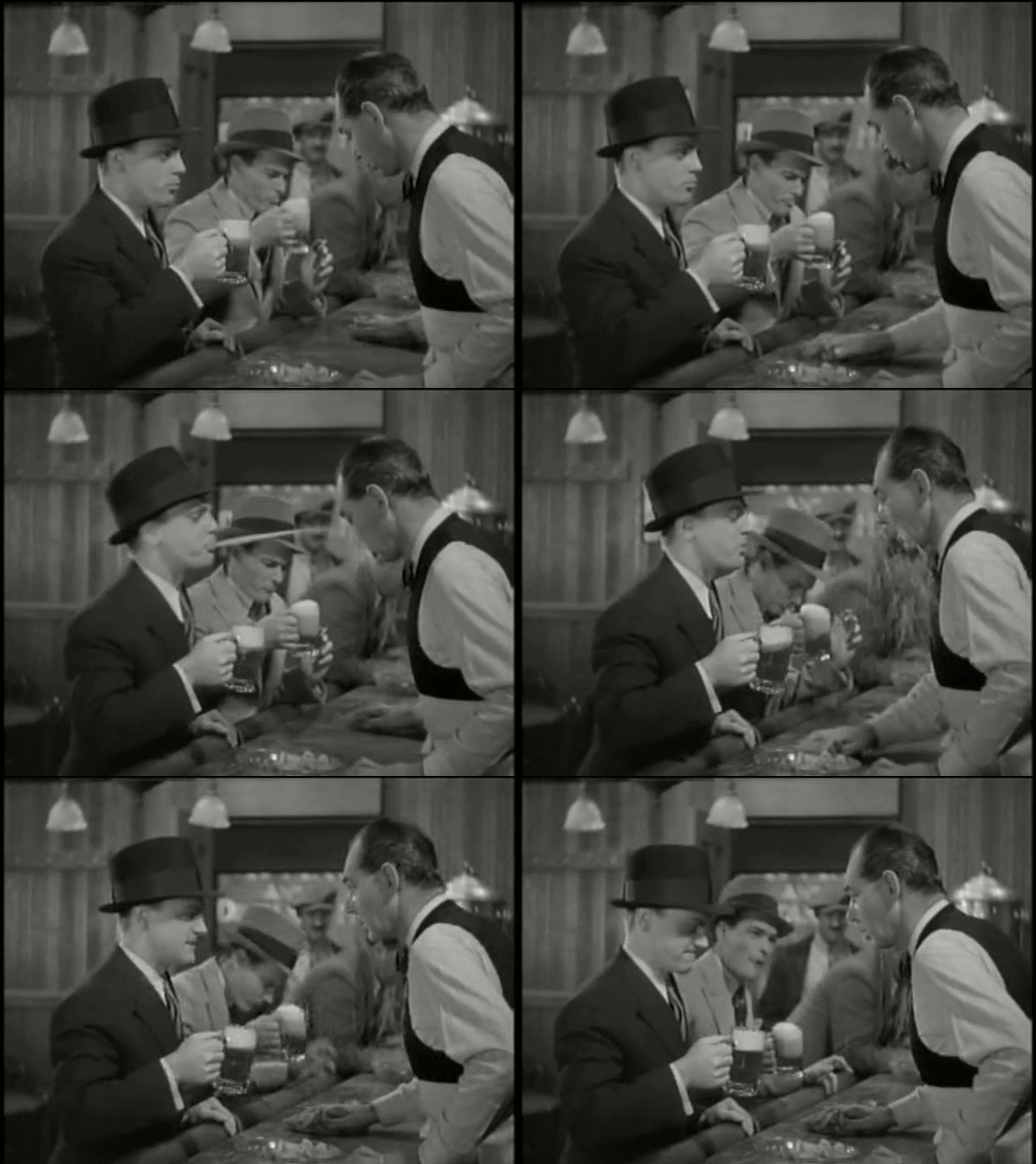
I think we can all agree that some movies offer great life lessons that we can tuck into our memory banks and carry with us, like loose change in our pockets or maybe lint, as we traverse through this unpredictable and awesome thing called life. I have found, for example, that the 1931 film "The Public Enemy" is stuffed like crazy with wisdom, and I can say without fear of contradiction that everything I need to know I learned from ... well, see for yourself.
Get regular exercise.
No spanking unless its consensual.
Be open to surprises.
Be respectful.
Encourage your loved ones to make healthy food choices.
Of all the actors and actresses who appeared in 1930s films, Dorothy Burgess (1907-61) was certainly one of them.
Here she is in the 1932 film "Play-Girl," opposite Winnie Lightner.
And who could forget her in "Hold Your Man," with Clark Gable and Jean Harlow?
Or "From Headquarters," with Kenneth Thomson?
And "Ladies They Talk About," with Barbara Stanwyck.
"Put up your dukes! I mean your duchesses!"
So, as you can see, the traditional Burgess role was the woman who was always picking herself up off the floor.
She was the troublemaker, the spiteful gossip, the jealous other woman. If you happen to be watching an old movie where one of the characters is always standing around with her hands on her hips, giving the stinkeye to the heroine, it's probably Burgess.
The niece of actress Fay Bainter, Burgess was born into a well-to-do Los Angeles family (dad was the first president of Western Airlines) and after a stint in a tony boarding school she made her Broadway debut while still a teenager in a play that starred Aunt Fay.
Like Myrna Loy, Burgess found fame in fiery temptress roles -- she played a gypsy girl in "The Squall" (a role Loy played in the film version) and an African-American woman in "Lulu Belle." She played a Mexican girl in her film debut, 1928's "In Old Arizona."
In late 1931, Burgess signed a contract with Warner Bros.-First National and began playing a string of mean girls.
In the 1932 film "Play-Girl," for instance, she is Edna, the bitter, negative counterpart to our heroine Buster, played by Loretta Young. Buster and Edna are sales clerks at the Mayfield Department Store, along with Buster's bosom buddy, Georgine (Winnie Lightner). Edna is a mean girl, always snidely criticizing the others:
Buster is swept off her feet by the brash Wallie, played by the hardly-ever-charming Norman Foster. They get married, and Buster thinks Wallie is a successful businessman who's always closing on big deals. Then he makes a confession -- the "deals" he's out making involve playing cards and poker chips! Then Buster makes a confession -- she's pregnant! They argue, and Wallie takes a powder. Buster is forced to return to the department store, and Edna is waiting to pounce:
In the 1933 films "Hold Your Man" and "Ladies They Talk About," Burgess crossed paths with Jean Harlow and Barbara Stanwyck, respectively. In "Hold Your Man" Burgess plays Gypsy, the old flame of Eddie (Clark Gable), who's now hooked up with Ruby (Harlow). In "Ladies They Talk About," Burgess is Susie, a religious fanatic and bonafide nutcase who has eyes for political reformer Dave Slade (Preston Foster). Unfortunately, Slade is all about Nan (Barbara Stanwyck), a convict in the same cell block as Susie, which leads to Burgess picking herself up off the floor.
In the 1933 crime drama "From Headquarters," Burgess is Dolly, the drug-addicted former girlfriend of a millionaire who's been murdered. At first she is a suspect, but under questioning her mental foundation shows signs of cracking like dried oatmeal:
By late 1933, Burgess's career began to sputter. She was in the headlines due to her involvement in an auto accident where a young woman was killed, and in July she was injured while filming -- of course -- a fight scene at Universal Studios. She appeared in only a handful of films after that, concluding with 1943's "The West Side Kid."
Of the half dozen films that Clark Gable and Jean Harlow made together, the 1933 film "Hold Your Man" is the only one where you're going to see crying -- from Gable.
Gable's without his trademark mustache in this film, and that bare upper lip seems to somehow add to his vulnerability. But beyond that, his character is a well-rounded blend of swagger and sensitivity -- a player who's knocked silly by love.
For that we can thank Gable's performance and the film's warm, funny, well-constructed screenplay, co-written by Anita "Gentlemen Prefer Blondes" Loos and based on her story. As Eddie and Ruby, two small-time hustlers who stumble upon each other, Gable and Harlow play real, flawed people with raw emotions; the kind of people who might end up being your grandparents -- or mine, at least.
"Hold Your Man" begins on the streets of New York City, where Eddie and his sidekick Slim (Garry Owen) are working a con straight out of "The Sting" that involves a "lost" wallet, a "diamond" ring and a greedy mark. Eddie's victim gets wise to him, and the cops give chase. He runs into an apartment building and dashes through the first unlocked door:
The apartment belongs to Ruby, a prototypical good-hearted Harlow dame. We learn right off the bat that she's been around -- she has photos of male admirers all over her apartment and a souvenir pennant from the Albany Night Boat, notorious for illicit assignations. And one of her neighbors comes in to borrow some gin that Ruby made herself.
Even though she's never met Eddie before, Ruby doesn't throw him out -- for one thing, he looks like Clark Gable, but more important is that by her nature she's even more hostile to the cops than she is to Eddie.
Eddie tries a few moves on her, but is ever-so-gently rebuffed -- Ruby threatens to hit him with a hot iron.
Eddie: You know all the answers, don't you?
Ruby: Sure -- to dumb questions.
Eddie thanks Ruby for her help and abruptly takes a powder. But he told her about his hangout, a local speakeasy, and she gets her boyfriend Al (Stuart Erwin being all Stuart Erwin-y) to take her there. She sees Eddie again, and he remembers her vividly, calling her "sweet meat." He tells her to ditch Al and come over to his place later. Then he bilks Al out of $10. Ruby comes over later -- to see Eddie and to take the money for herself.
Eddie: Wait'll you see how I grow on you.
Ruby: Yeah, like a carbuncle.
Their rendezvous is briefly interrupted by Slim and a couple of women, including Eddie's old flame Gypsy (Dorothy Burgess). She slaps Ruby, and ...
Exeunt Gypsy.
The next morning we see breakfast for two, and Ruby's wearing the same dress. It's almost as though they're trying to tell us something.
Then Slim enters -- he has a job for Eddie involving the theft of a truck loaded with silks. Ruby warns Eddie not to get involved, but he says he's always been lucky.
Cut to the city jail:
By the time "Lucky" gets out of stir, it's close to Christmas. Ruby has fixed up Eddie's apartment to welcome him home, and she also goes out of her way to leave a letter lying around written by a male admirer. The idea is to make Eddie jealous, but his thoughts turn to blackmail because the guy gives the impression of being well off. Ruby goes along with the plan, but on the day of the caper Eddie's overcome by jealousy -- he bursts in, knocks out the mark, and takes Ruby to get a marriage license.
On their way back to Eddie's apartment, they learn that the mark has died. Eddie disappears and Ruby is sent up for the crime to a woman's prison that seems more like a convent. And one of her roommates is her old nemesis Gypsy. Ruby has no idea where Eddie is, but Gypsy taunts her daily about the letters and money he sends her. Ruby knows better.
The final sequence of "Hold Your Man" takes place on Easter Sunday, and without getting too theological let's just say it ends up being the day that Eddie and Ruby's relationship is resurrected.
It's visiting day, but Ruby isn't expecting any visitors. So when one of her friends acts out and has her visitation jeopardized, Ruby takes the rap to allow her friend to see her sister.
Then Ruby learns that she has a visitor after all -- it's Eddie. And because he's a wanted man, he pretends to be a brother to one of the other inmates. In a wonderful scene filled with tension, Ruby and Eddie edge ever closer to each other in a room crowded with family members visiting their inmates, but Ruby gets placed in solitary just seconds before she and Eddie can reunite.
What happens next is what, to me, makes "Hold Your Man" so unique. Ruby's friends, working behind the back of the prison matrons, work together to reunite Ruby and Eddie. They're like the animals who help Cinderella in the Disney film. One of the other inmates, an African-American woman, is visiting with her father, a minister. And an emotional Eddie approaches him to ask a favor.
Eddie: I know it ain't according to Hoyle -- but you'll be giving two people -- no, three -- a break.
Eddie then breaks down.
So we have an African-American minister marrying a white couple -- oh, and the woman is pregnant. I personally don't know how to say "pre-code" any louder. The wedding commences as we hear the police approaching. And this scene kills me:
Gable and Harlow made the great "Red Dust" together, but to me "Hold Your Man" is a much more resonant and ambitious movie. It could have been made yesterday. It's not one of those old movies that you watch from a safe emotional distance -- you engage and identify with the characters. You feel you're watching something special take place between two people, and the climax gives you a shudder of emotion -- a frisson.
The 1932 film "Red Dust" is ironically titled -- dust has very little to do with what happens in the movie. Moisture, however, plays a starring role -- moisture in the form of sweat, rain, steam and humidity, with a very special appearance by Jean Harlow's bathwater.
Set on a rubber plantation in Indochina, with the nearest large city being Saigon (they pronounced it "say-gone" in those days), "Red Dust" deals with Denny (Clark Gable), a rough-and-tumble plantation boss who's torn between two women -- earthy goodtime girl Vantine (Jean Harlow) and icy yet smouldering Babs (Mary Astor). The three of them face one crisis after another -- windstorms! Rainstorms! Tigers! Fever! The Chinese cook's bad teeth!
Vantine appears first -- we see her in bed, where she has gone to sleep and hide from a drunken worker (Donald Crisp), and she's illuminated by Denny's flashlight. This happens on a steamy night when Denny just happens to be in a bad mood -- he's on one of his periodic rants to the wizened McQuarg (Tully Marshall) about how he'd love to leave the whole grueling business: "Swallowing dust one month, wading in mud the next -- just so some old woman can take a hot water bottle to bed with her."
Vantine has taken the boat (On water!) to the plantation to hide out from the authorities. She doesn't say why she's in trouble, but from her appearance and filmy wardrobe we can guess.
Vantine: What else do you do around here besides work? Know any games?
McQuarg: If it was the summer of 1894, I'd play games with you, sister.
Then she tries to strike up a conversation with Denny:
In a nice touch that Howard Hawks would steal -- er, adopt -- in "To Have and Have Not," Denny and Vantine make up different names for each other. She calls him Fred, and he calls her Lily. And they end up playing other games together, if you know what I mean, and I think you do.
Both Harlow and Gable are surprisingly assured in their roles -- even more so for Harlow. Her star was still on the rise and it was during the making of this film that her husband, MGM executive Paul Bern, committed suicide. But Harlow gets all the film's best lines and knocks them out of the park -- for instance, while cleaning a bird cage, she
asks the occupant, "Whaddya been eating? Cement?"
Fast forward a few weeks, and Vantine is ready to board the boat back to civilization. Arriving on that very same boat is Willis, the plantation's new surveyor (Gene Raymond), and his wife, Babs.
You can tell that the Willises aren't quite prepared for the rugged conditions they find -- they've packed tennis rackets, and when she sees the plantation headquarters, Babs asks where the main house is. On top of everything else, Willis has a tropical fever and he spends the next week or so sweating like crazy. Denny nurses Willis through his fever, and earns the gratitude of Babs. He likes that -- he likes her. Meanwhile, Vantine's back -- the boat has had mechanical trouble.
So there's a full house, and once Willis has recovered, Denny sends him on several long-distance missions so that he can make a play for Babs. He takes her on a tour of the plantation, and they get caught in a downpour, which has a way of breaking down, um, formalities:
Vantine can't figure out why Denny goes for a cool customer like Babs. But she just goes her own merry way while she's waiting for the boat to be repaired. This includes using the camp water supply as a bathtub, with Denny as a flustered observer -- not flustered for his sake, but for Babs's sake, for God's sake:
(By the way -- when Harlow basically played herself in the great 1933 Hollywood satire "Bombshell," there's a scene when her character, Lola Burns, has to do "Red Dust" retakes in the bath barrel.)
Despite Denny's infatuation, it's pretty clear that Babs isn't right for him. Unlike Vantine, she calls him "Dennis" and wouldn't think of joking around or pitching a double entendre. And when Denny goes to visit Willis in a remote location, he finally understands how much the guy loves his wife and how out of place Babs would be on a rubber plantation. (Babs, in fact, is the film's only sweat-free character, making her seem even less human.)
So Denny gets noble and comes back to break up with Babs. She doesn't take it well, and she has a gun, so Denny gets shot. Then Willis arrives, and Vantine steps in:
For them, the plantation is home, sweat home.
Here are full credits for "Red Dust," and a trailer:
The 1932 film "The Beast of the City" opens with a long-winded bit of argle-bargle from President Herbert Hoover to the effect of, dude, if movies glamorize gangsters all the time, how about a movie that glamorizes the cops instead?
Louis B. Mayer, the head honcho of MGM, was a big Hoover supporter, and slapping that statement at the beginning of "The Beast of the City" gives it a kind of moral authority and civic veneer, which is funny because the movie -- especially its no-holds-barred ending -- is every bit as violent as the popular gangster films of the day. The film's scriptwriters are W.R. Burnett (creator of "Little Caesar") and John Lee Mahin (co-writer of "Scarface"). The movie is also an impressive showcase for a young Jean Harlow, and gives us an early glimpse of Mickey Rooney.
Our hero is police Captain Jim Fitzpatrick, played stolidly by Walter Huston. Jim is stern, unsmiling and uncorruptable, but he's constantly foiled in his efforts to put gangster Sam Belmonte (Jean Hersholt) behind bars because of Belmonte's lawyers and their knowledge of "rights."
Fitzpatrick is also a solid family man, with a devoted wife, twin daughters and a rambunctious son played by Rooney, billed here as Mickey Mcguire. (Amazing that a guy who was in a movie made 80 years ago is still with us.) Rooney is around mostly for comic relief:
Because his crusade against Belmonte is making the corrupt chief look bad, Fitzpatrick is transferred to a safer, rural district. There he foils a bank holdup and gets wounded in the process, becoming a hero. This results in his promotion to Chief, a job he tackles with the same grimness of purpose.
Meanwhile, Fitzpatrick's brother Ed (Wallace Ford) poses a problem. He's also a cop, but not as conscientious as Jim, and to make matters worse he falls for Belmonte's moll, Daisy (Harlow):
As Jim's anti-corruption crusade gains strength, Ed falls further from grace. Finally, he's arrested for his involvement in a robbery/murder. But because of threats from Belmonte's thugs and fast work by his attorneys, Ed is acquitted. He begs his brother's forgiveness, but only one thing can set things straight -- Ed joins Jim (and about 25 other cops) in a shootout with Belmonte's gang that's positively operatic in its body count:
Weird choice for a closing theme, eh? And don't forget the message -- courtroom justice is all well and good, but the best way to deal with criminals is to ambush and kill them before they kill you.
Here are the full credits for "The Beast of the City."
We know what -- and who -- "Bombshell" (1933) is about from the get-go:
Burns is the name, Lola Burns, and any resemblance to Jean Harlow is purely intentional. She's platinum blonde, she's an international sex symbol and she's the star of "Red Dust." She lives in a gorgeous Hollywood mansion along with her sponging father and brother (Frank Morgan and Ted Healy), a wisecracking maid (Louise Beavers) and faithful assistant (Una Merkel).
At the studio, Burns is hounded by a persistent stalker and by fast-talking, fast-thinking studio publicity man "Space" Hanlon, played by Lee "Aw, sugar, you got me all wrong" Tracy:
"Bombshell" moves as fast as Tracy talks. At any given moment in any given frame of this movie, someone is leaving, coming in or passing by. The dialogue is just as fast and funny, as when Space is justifying what he's done for Lola:
"I've seen to it that Lola Burns is a family slogan from Kokomo, Indiana to the Khyber Pass! Strong man take one look at your picture and go home and
kiss their wives for the first time in ten years! You're an international tonic! You're a boon to re-population in a world thinned out by war and famine!"
There's also great dialogue involving Beavers as Harlow's maid. In one scene she tells Harlow that the negligee Harlow gave her was "torn." "Your day off is sure brutal on your lingerie," Harlow says. And when Merkel, as Harlow's assistant, tries to bully Beavers, she responds, "Don't scald me with your steam, woman. I know where the bodies are buried!"
"Bombshell" also has great footage of the real-life MGM lot and surrounding buildings -- how many liaisons, you wonder, began at Ryan's Cafe just outside the studio gate? And it has a healthy sense of humor about Hollywood, spoofing fan magazines, gigolos with phony royal titles and stars adopting babies because it makes good copy. When Burns expresses an interest in adopting, Space stops her short -- "You think I want my bombshell turned into a rubber nipple?"
The movie ends with a "His Girl Friday"-style twist -- Burns runs away from the studio to a dude ranch and starts to worry if the studio really misses her. She also falls for a rich young man (Franchot Tone) who seems perfect -- too perfect.
As much as "Bombshell" lampoons the studio system, however, it's interesting that two of the male leads -- Tracy and Healy -- would go on to violate system rules and end up in big trouble. In 1934, MGM suspended Tracy for his drunken hi-jinks on the Mexican set of "Viva Villa," and his career was never the same. And Healy died in 1937 under suspicious circumstances -- at least one book contends that he was beaten to death by a group including MGM star Wallace Beery, and that MGM sent Beery out of the country until the hubbub died down.
You can find complete credits for "Bombshell" here.
Give Frank Capra credit -- once the guy found a formula, he stuck with it. Specifically -- an honorable man, pure at heart, up against powerful and/or wealthy forces out to destroy or at least ostracize him. You can apply it to almost any Capra film, from "Mr. Smith Goes to Washington" to "Meet John Doe" to "It's a Wonderful Life" to "A Hole in the Head."
And this isn't meant as a criticism -- if the idea was a little familiar, Capra knew enough to work with writers who infused his scripts with lively, humorous dialogue. And Capra put the words in the mouths of some of Hollywood's best actors -- Gary Cooper, Barbara Stanwyck, James Stewart, Thomas Mitchell, Jean Arthur. And his own background as a gagman and director of comedies for folks like Harry Langdon didn't hurt, either.
Still, it is interesting to see the idea of the "Cinderella Man" and the phrase itself being introduced in Capra's 1931 film "Platinum Blonde." Clearly it captured the public's imagination -- columnist Damon Runyon applied it to boxer James Braddock in 1935 (director Ron Howard used it as the title of his 2005 film about Braddock), and it pops up again in Capra's "Mr. Deeds Goes to Town" in 1936.
Anyway, back to "Platinum Blonde." The titular heroine of the 1931 film is Jean Harlow, who singleheadedly made the haircolor famous. She's Ann Schuyler of THE Schuylers, a high-society family whose blood is as blue as their noses. When the Schuyler son gets mixed up in a scandal with a chorus girl, Ann's path crosses that of reporter Stew Smith (Robert Williams). She takes a fancy to him and tries to sweet talk him into caving on the story. He doesn't do that -- he might be a goofoff and a drinker, but he's a dedicated newspaperman. But once the story is published, he does help her out:
A romance develops between Ann and Stew, and they get married. She almost immediately begins to try and change him, though he resists. All of this happens to the dismay of Stew's best "buddy" on the newspaper, Gallagher, played by an 18-year-old Loretta Young, already demonstrating her acting chops:
And speaking of acting chops, "Platinum Blonde" is a real showcase -- tragically, one of the only ones -- for Robert Williams. He'd done a fair amount of stage work before coming to Hollywood, including a long run in the Broadway hit "Abie's Irish Rose," but in this role he's a movie natural -- and sadly, he died of peritonitis just after this film was released. With his pipe, easy-going manner and hooded eyes, he's an early Bing Crosby. His rapport with Harlow is so obvious that they can get away with scenes like this, when she tries to make him wear garters:
Young is luminous as the girl who gets left behind, at least temporarily. And the cast includes old pros like Walter Catlett and Halliwell Hobbes. There aren't many other 1931 films that move with the style and assurance of "Platinum Blonde," made when Capra was hungry and still making a name for himself as a real-life Cinderella Man.