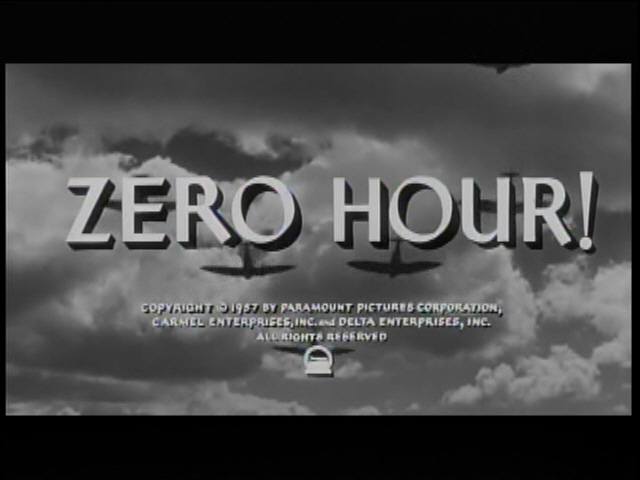
On Screen Capture Theatre we condense a movie into a concise, but thrilling, handful of images. Today we feature the first airplane disaster movie, "Zero Hour," from 1957. A great film tells its story solely through visuals. And I guess "Zero Hour!" does, too.
Herewith we present the film in a unique pictorial form utilizing pictures of a visual nature designed to tell the story through images in a visual, pictorial manner that includes the use of pictorial images that are visual.
Our story begins on a beautiful day during World War II.
Dana Andrews plays Ted Stryker, a World War II squadron leader who
caused all of his men to crash. A lot. Now he is haunted and stuff.
Stryker's wife (Linda Darnell) is tired of having a haunted husband,
so she has taken son Bobby and left Stryker. Little does she know that the plane they have boarded is on a flight to disaster, with a quick connection at Kansas City.
In pursuit of his wife and son, Stryker boards the same plane and ends
up sitting next to Rob Petrie's neighbor, Dr. Jerry Helper.
Bobby visits the cockpit, where co-pilot Clutch Cargo gives him a toy plane.
Jerry Helper has a neurotic condition where he can talk only through his puppet, Dr. Yarnfinger. When asked whether he wants halibut or lamb chops for dinner, Dr. Yarnfinger chooses lamb chops. Well played, Dr. Yarnfinger.
The special effects could be better.
Turns out most of the passengers and both of the pilots have eaten
bad halibut and have food poisoning. To save his family, Ted Stryker must fly a plane again!
Unfortunately, it's been so long since Stryker flew that he's forgotten
where his ears are -- and that, for best results, a pilot's eyes must be open.
And yet Stryker's wife bravely supports him every step of the way.
Stryker gets off to a rough start, and knows that only one man can help him ...
... Gen. Jack D. Ripper. He knows Stryker's history, and even gave him an affectionate nickname -- "cowardly pilot-killing incompetent sissy who crashes a lot." He is the ideal man to instill confidence in Stryker.
A doctor on board tries to distract the passengers with a singalong:
"Who knows 'The Wreck of the Edmund Fitzgerald'?"
The passengers seem calm ...
"Dr. Yarnfinger ate halibut off of someone's plate and he
has food poisoning, too. He's doing weird things down my sleeve."
Ripper tells Stryker that thanks to the potency of his bodily fluids, he's doing a great job, and pay no attention to the hundreds of emergency vehicles lining the runway. They're just curious because they've never seen a disastrous crash before.
Finally the plane makes a smooth, relaxed landing.
And who knew this was one of those experimental planes
that used fire instead of landing gear?
Somebody's gettin' a little somepin-somepin tonight, oh yeah.
"Wait till Dr. Yarnfinger tells Millie about this!"
A great film tells its story solely through visuals.
And I guess the 1957 movie "Zero Hour!" does, too.
Herewith we present the film in a unique pictorial form utilizing pictures of a visual nature designed to tell the story through images in a visual, pictorial manner that includes the use of pictorial images that are visual.
Our story begins on a beautiful day during World War II.
Dana Andrews plays Ted Stryker, a World War II squadron leader who
caused all of his men to crash. A lot. Now he is haunted and stuff.
Stryker's wife (Linda Darnell) is tired of having a haunted husband,
so she has taken son Bobby and left Stryker. Little does she know that the plane they have boarded is on a flight to disaster, with a quick connection at Kansas City.
In pursuit of his wife and son, Stryker boards the same plane and ends
up sitting next to Rob Petrie's neighbor, Dr. Jerry Helper.
Bobby visits the cockpit, where co-pilot Clutch Cargo gives him a toy plane.
Jerry Helper has a neurotic condition where he can talk only through his puppet, Dr. Yarnfinger. When asked whether he wants halibut or lamb chops for dinner, Dr. Yarnfinger chooses lamb chops. Well played, Dr. Yarnfinger.
The special effects could be better.
Turns out most of the passengers and both of the pilots have eaten
bad halibut and have food poisoning. To save his family, Ted Styker must fly a plane again!
Unfortunately, it's been so long since Stryker flew that he's forgotten
where his ears are -- and that, for best results, a pilot's eyes must be open.
And yet Stryker's wife bravely supports him every step of the way.
Stryker gets off to a rough start, and knows that only one man can help him ...
... Gen. Jack D. Ripper. He knows Stryker's history, and even gave him an affectionate
nickname -- "cowardly pilot-killing incompetent sissy who crashes a lot." He is the ideal man
to instill confidence in Stryker.
A doctor on board tries to distract the passengers with a singalong:
"Who knows 'The Wreck of the Edmund Fitzgerald'?"
The passengers seem calm ...
"Dr. Yarnfinger ate halibut off of someone's plate and he
has food poisoning, too. He's doing weird things down my sleeve."
Ripper tells Stryker that thanks to the potency of his bodily fluids,
he's doing a great job, and pay no attention to the hundreds of emergency
vehicles lining the runway. They're just curious because they've never seen
a disastrous crash before.
Finally the plane makes a smooth, relaxed landing.
And who knew this was one of those experimental planes
that used fire instead of landing gear?
Somebody's gettin' a little somepin-somepin tonight, oh yeah.
"Wait till Dr. Yarnfinger tells Millie about this!"
In the beginning, it's the point of re-entry for three World War II vets -- banker Al (Oscar-winner Fredric March), soda jerk turned bombardier Fred (Dana Andrews) and sailor Homer (Harold Russell), who has lost both of his hands and has become pretty adept with hooks.
All three are coming home to Boone City, a midwestern metropolis not unlike Indianapolis or Cincinnati. And all three, for individual reasons, are scared stiff about reintroducing themselves to their loved ones and readjusting to civilian life.
The three of them have hitched a ride on an Army transport plane, taking a route back home that includes many stops along the way. This gives them time to share their stories, especially Homer, who is convinced that longtime girlfriend Wilma (Cathy O'Donnell) will leave him:
"The Best Years of Our Lives" is very much a product of its time -- that time being just after the allied victory in World War II, a victory that solidified America's position as a global power. At the same time, we came out of the war with a clearer understanding of the depths of evil and of how far we as a country still needed to go to ensure true equality for all of its citizens.
The film is ripe with the potential and the pitfalls of possibility -- of lives restarting, in the case of Al and his wife Milly (Myrna Loy); and of lives beginning, in the case of the forbidden romance of Fred, who is already married, and Al's daughter Peggy (Teresa Wright); and of Homer's difficult adjustment and gradual acceptance of the love of longtime girlfriend Wilma.
Director William Wyler handles each actor with delicacy and skill, but to me the most outstanding feature of "The Best Years of Our Lives" is the screenplay by Robert Sherwood, based on a story by MacKinlay Kantor. Sherwood's script contains some great, sharp-edged lines. One of my favorites is spoken by Al as he downheartedly prepares to return to the bank:
Al: Last year it was 'Kill Japs.' This year it's 'Make money.'
Another favorite scene is when Homer flees to the neighborhood tavern owned by his Uncle Butch after an uncomfortable re-entry with his family. Butch, beautifully played by songwriter Hoagy Carmichael, slowly plinks out "Up a Lazy River" on the piano (which Carmichael composed) and has a great little monologue.
Butch: Give 'em time, kid; they'll catch on. You know your folks'll get used to you, and you'll get used to them. Then everything'll settle down nicely. Unless we have another war. Then none of us have to worry because we'll all be blown to bits the first day.
But it's the visual moments that give this movie its real staying power, from Homer's return home to the arrival of Al at his apartment, where he surprises Milly:
And, at the end of the film, back at the airfield, Fred's visit to an airplane graveyard to put to rest some ghosts of his own while his hard-drinking father reads his son's citations:
I've been a fan of older movies since I was a kid, but as I have aged I see "The Best Years of Our Lives" through different eyes. It's a tremendously moving yet down-to-earth movie, its simple nobility enhanced by Hugo Friedhofer's Oscar-winning score. The movie ends with the wedding of Homer and Wilma, and the impending marriage of Fred and Peggy and, to me, the sense of it being very early morning of a whole new day.