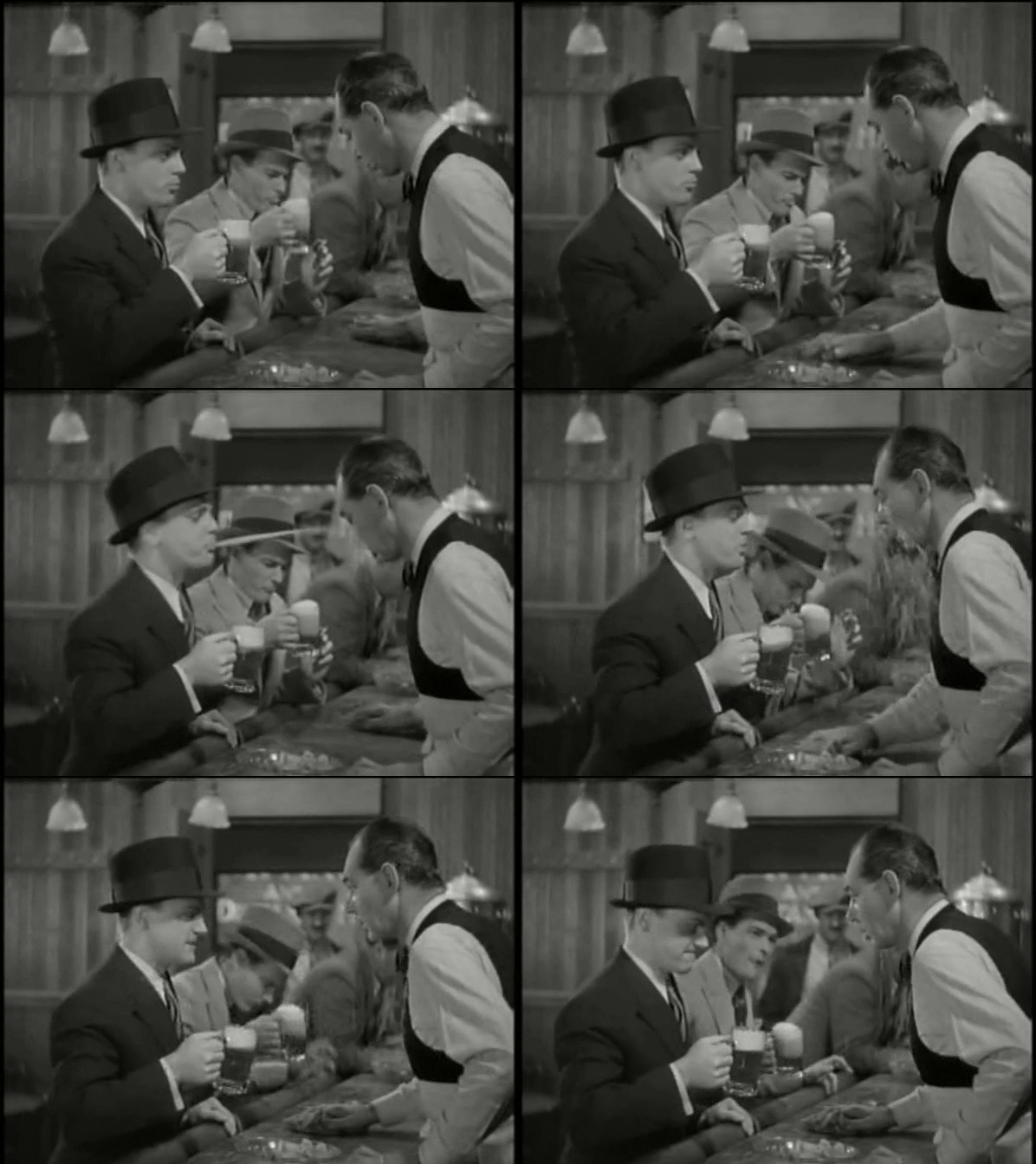
I think we can all agree that some movies offer great life lessons that we can tuck into our memory banks and carry with us, like loose change in our pockets or maybe lint, as we traverse through this unpredictable and awesome thing called life. I have found, for example, that the 1931 film "The Public Enemy" is stuffed like crazy with wisdom, and I can say without fear of contradiction that everything I need to know I learned from ... well, see for yourself.
Get regular exercise.
No spanking unless its consensual.
Be open to surprises.
Be respectful.
Encourage your loved ones to make healthy food choices.
I bow to no one in my admiration for, and possibly creepy love of, Myrna Loy. That little pug-nosed, round-faced, level-headed, wry-humored vixen was sexy, smart and sweetly funny -- the perfect screen wife. Who cares that in real life she was married four times -- this is why movies are awesome!
Loy's true breakthrough role came in 1934's "The Thin Man," directed by W.S. Van Dyke and with a screenplay adapted by Frances Goodrich and Albert Hackett. Van Dyke, Hackett and Goodrich are also all on board for the 1933 film "Penthouse," so you have to wonder if Loy's performance in this film served as a kind of screen test for "The Thin Man."
In "Penthouse" Loy plays Gertie, a call girl whose roommate, Mimi (Mae Clarke), is shot in the first five minutes of the movie. Gertie wants to find the killer, and so does hotshot defense attorney Jack Durant (Warner Baxter). Durant's interest is personal -- Tom, the accused murderer, (Phillips Holmes) is in love with his ex-girlfriend Sue (Martha Sleeper, whose last name describes her performance), who has begged Durant to take the case.
As the film opens, Durant has just won acquittal for his client, mobster Tony Gazzotti (Nat Pendleton). In this case, at least, Gazzotti was genuinely not guilty, so Durant is a hero. But not to girlfriend Sue. He shows up to greet her on Long Island in his best white flannels and a pimpin' hat, but she gives him the cold shoulder:
Durant goes on a drunk, and the next day he's debriefed on the previous night's events by loyal butler Layton (Charles Butterworth):
(Charles Butterworth should be every butler in every New York City apartment in every 1930s movie.)
Ex-girlfriend Sue then comes to Durant for help, because Tom has been accused of murdering Mimi, his old girlfriend. And Durant goes to work, with the help of Gertie. They've been introduced by Gazzotti, who adds "she's the kind you can take home to dinner, and no hard feelings if you don't stay for breakfast." Gertie is attracted to Durant, and she accompanies him to his apartment to spend the night -- her place, which she shared with the dead Mimi, gives her the heebie-jeebies. Gertie is ready for Durant to put the moves on her, and she's a little baffled when he doesn't.
Gertie: Say, are you still in love with someone, or are you just decent?
Durant: Maybe I think you're decent.
Gertie: A girl who comes into a man's apartment at night?
Durant: Well, you might have come here just to look at the Chrysler Building.
There are certain faces in 1930s movies that mean bad news from the
get-go. For instance, never do business with C. Henry Gordon (aka evil
Fred Astaire). Here he is mobster Crellimen, the man behind Mimi's murder. And as Gertie and Durant team up to nab Crellimen, Durant realizes he's falling in love with Gertie. This dawns on him in a scene where Baxter and Loy have a nice dialogue that echoes "The Thin Man":
Loy really does shine in this film -- at this stage in her career she was finally leaving behind the oriental temptress roles she played in movies like "Thirteen Women" and "The Mask of Fu Manchu" and within a few years she'd be the queen of the MGM lot -- after "The Thin Man" came such hits as "Libeled Lady" and "Test Pilot." She plays her role here simply and realistically, without the histrionics of Joan Crawford or the melancholy of Garbo.
Baxter doesn't fare quite as well -- even when he's playing a streetwise character like Durant, he can't shake his tendency toward leading-man pomposity. He looks especially uncomfortable during the romantic clinch in the final scene, when Loy musses his hair, and why any man should object to Myrna Loy mussing his hair is beyond me:
Here are the complete credits for "Penthouse," and a trailer:
"Don't tell anyone, but
my real name is Mary Klotz."
Of all the actresses who appeared in 1930s movies, Mae Clarke (1910-1992) was certainly one of them.
She played a variety of roles, including rather wooden reporter, rather wooden gangster's moll, rather wooden movie star, rather wooden bride carried away by Frankenstein and rather wooden prostitute. And she will go down in film history for this scene:
Clarke's kisser was a pretty one, and deserved -- and got -- better than a grapefruit half in most of her movies. She had the good fortune to appear in several true film classics, including "The Public Enemy," "Frankenstein," the first version of "Waterloo Bridge" and the original version of "The Front Page." She was capable of convincing work, but in average movies headed by average directors she tends to deliver her lines as if she was thinking about something else.
In the 1931 film "The Good Bad Girl" she gets to dip her toe into soap opera -- a territory dominated at the time by the likes of Kay Francis and Norma Shearer. She is Marcia, a reluctant gangster's moll. As the movie opens, she is trying to leave the big lug, but as Neil Sedaka so memorably said, breaking up is hard to do. Or, as the gangster (Robert Ellis) says, "There's only one way for either of us -- feet first," which does not have much of a danceable beat. Then the gangster leaves to settle a score with an old rival, which he does in kind of a memorable way:
The gangster wants Marcia to give him a fake alibi, but she refuses. She has fallen in love with another man (James Hall). The gangster is imprisoned and swears vengeance, and Marcia marries the other man even though he doesn't know about her past. When he and his high-society family find out, she is shunned, even though she's with child. Marcia has the baby, and the gangster escapes from prison, intent on tracking down and killing her. He makes it as far as the baby's nursery, where the police shoot him down like a dog. At the same time, rich husband has come to his senses and sets out to reconcile with Marcia.
"The Good Bad Girl" gives Clarke several opportunities to do some heavy-duty emoting, and she is convincing as the young mother set adrift. As Marcia's boozy pal, silent-film beauty Marie Prevost is aces with comedy relief, and things chug along until the inevitable happy ending:
In 1932's "The Final Edition," Clarke is reporter Ann Woodman, and the first part of her last name describes her performance. When she acts sassy or makes with a wisecrack, it's almost as if she doesn't understand it's a joke. Someone like Glenda Farrell would be knocking these lines out of the park, you get me?
Anyway, Ann wants to be a reporter but boyfriend Bradshaw (Pat O'Brien), who's also the city editor, doesn't think she's up to the job. Ann gets her chance when the new police commissioner is murdered and she jumps in to console the man's wife:
She scoops the competition with details about the murder and then she follows the killer to a resort hotel where he's hiding out. The bad guys catch on and she and Bradshaw end up in hot water, at least temporarily:
The newspaper picture was a stock-in-trade at Warner Bros., where O'Brien was under contract, so he fits right in, talking a mile a minute. For instance, try to decipher what he's saying here:
As for Clarke, her career continued into the 1960s, but with smaller and smaller roles. Her other credits include "Singin' in the Rain" (as a hairdresser), "The Catered Affair" (as a saleswoman) and "Pat and Mike" (as a golfer).