Showing posts with label Stuff I Read in Variety Back Issues. Show all posts

Crooner Embarrasses Woman -- to the Tune of $10,000?!

In late 1931, Susan Hall went to a movie and live show at the Rialto Theatre in downtown Louisville (the theatre was on Fourth Street, just across from what is now the Louisville Palace; it was demolished in 1969). Anyway, the show featured a crooner named Don Galvin, and during his act he came down into the audience, sat next to Susan Hall, and sang to her.

As a result, Susan Hall went into what we used to call a conniption, getting hot and bothered by the attention.

And so, a few weeks later, she sued the management of the Rialto. Here's how the suit was described in Variety:


The article appeared in December 1931. We don't know what became of the suit, or of Mrs. Hall, or Don Galvin.     

In 1954, Louisville Loved Liberace

In the mid-1950s, Variety tracked the performance of syndicated TV shows by publishing the ratings for those shows in many markets. One of them was Louisville.

This is from July 1954, and as you can see, "Liberace," airing on WAVE on Wednesday nights, was the ratings champ by a mile, more than 24 points ahead of "Ramar of the Jungle," airing on WHAS on Tuesday nights. Noting the competition is also interesting -- "Liberace," a big favorite with women viewers, was outpacing boxing matches known as "Blue Ribbon Bouts" (sponsored by Pabst Blue Ribbon Beer). "Ramar" was leading, by a wide margin, the network dancing show "Arthur Murray Party." And the hysterical historical anti-Communist drama "I Led Three Lives" led the locally-produced "Pee Wee King Show" on WAVE. Let's also note the connection of longtime WAVE announcer Bob Kay to two items on this list -- he was the announcer on "The Pee Wee King Show," doing commercials for Oertel's 92 Beer, and he was the host of "Pop the Question," a locally produced game show being beaten up by "The Cisco Kid" every Sunday afternoon. ("Question" was gone by the fall.)     

The WHAS Crusade for Children, Take One

The 69th annual WHAS Crusade for Children took place earlier this month, raising over $5 million to support children with special needs in Kentucky and Indiana. For decades the Crusade has been a well-oiled fundraising machine, utilizing volunteers from across the region who do everything from holding benefit events to walking door to door for contributions.

The Bingham family, who owned WHAS when the Crusade began, well understood its standing as a community institution -- when they sold WHAS in the mid-1980s, they included a covenant that the subsequent owners could never cancel the Crusade.

Here's how it started, on September 12, 1953, according to Variety:


You're forgiven if the celebrities, aside from singer Mel Torme and tennis ace Pancho Gonzales, don't ring a bell. Ray Malone was a tap dancer who, a few years earlier, had been a regular on the NBC late-night show "Broadway Open House." Here he is with Dean Martin and Jerry Lewis. Fran Warren was a singer whose biggest hit was "A Sunday Kind of Love." Robin Morgan was 12 at the time -- she was a young actress who played Dagmar on the TV series "Mama." Today she's a poet and activist. I don't have the slightest idea who Mary Farenga is.

The telethon happened before my time, but I did hear one behind-the-scenes story about it. Legend has it that Mel Torme (seen here with Crusade emcee Jim Walton) got very upset when the crowd in Memorial Auditorium gave him only polite applause while they went crazy for Randy Atcher. Sorry, Velvet Fog, but there's no fighting the power of "T-Bar-V Ranch" -- at least not in Louisville. 


Whaddya Mean, a Hoosier Queen?!

On Wednesday, January 28, 1948, the Mutual Network radio show "Queen for a Day" came to Louisville for a live broadcast, setting up shop in what is now Louisville Gardens for a broadcast over station WGRC, which later became WAKY. 

On each episode, several women with hard-luck stories competed to be chosen as "Queen" and receive tons of prizes from emcee Jack Bailey, seen at right holding a highly coveted -- Dishmaster Deluxe? Anyway, I'll let the article from Variety tell the rest of the Louisville story:


Grandma Dixie and the Feds

I've already written about my Grandma Dixie a time or two. She had the unique ability to play piano by ear, by just hearing a song and then pounding it out. Consequently she kept very busy, playing solo gigs and with musical groups all around Louisville from the 1930s until the early 1980s.

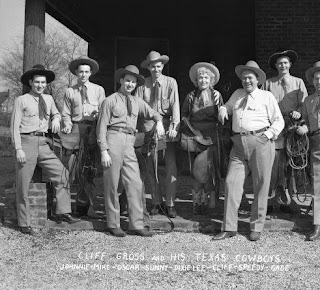
The groups she performed with most often were Clayton "Pappy" McMitchen and His Georgia Wildcats, and Cliff Gross and His Texas Cowboys. The photo at left shows her with Cliff Gross's group, and just around the time that photo was taken, Cliff Gross got into a little trouble with the gubmint.

In the summer of 1943, we were in the thick of World War II and gas rationing had been in place for about a year.

Except, apparently, for the Cliff Gross musical aggregation.

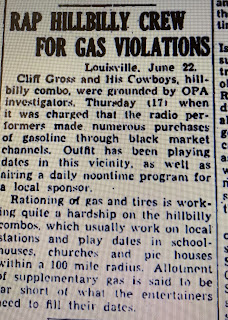
On June 17, the U.S. Office of Price Administration grounded Gross, all the Cowboys and one Cowgirl, charging them, according to this article from Variety, with purchasing gasoline through the black market. Was Grandma Dixie complicit or did she just go along for the ride? We will never know, ladies and gentlemen of the jury. Here's the story:


Grandma Dixie Is on the Air!

My dad's mother grew up in Missouri in the early 1900s, and she had a unique talent -- she could play piano by ear. She could hear a song and then, instinctively, pound it out on a keyboard. No training. No lessons. This became her livelihood -- she first earned money accompanying silent movies, and during the Great Depression she helped support her family by playing gigs all over Louisville, often as Dixie Lee. She played on the radio. She played with touring bands, including Clayton "Pappy" McMichen and His Georgia Wildcats, and Cliff Gross and His Texas Cowboys. She played "The Star Spangled Banner" before wrestling matches at the Louisville Armory. She performed with nationally-known musicians who would play the National Theatre, which was located at the corner of Fifth and Walnut streets downtown. (Walnut is now Muhammad Ali Boulevard.) And in 1950, Dixie Lee was part of a morning radio show that originated at a Louisville restaurant -- part of a group, according to Variety, "who have been kicking around this area on hillbilly shows and nitery floors for many a year." Here's the review from Variety:


More to come on Grandma Dixie and her colorful career.