This is part of the CMBA Fall Blogathon: Trains, Planes and Automobiles. Check out all entries!
The star of the 1934 film "The Silver Streak" isn't first-billed Sally Blane, or even male lead Charles Starrett.
It's the future.
Specifically, it's the future in the form of the Pioneer Zephyr, a streamlined diesel train here called the Silver Streak. But incidental roles in the movie are played by the Century of Progress International Exposition, also known as the 1933-34 Chicago World's Fair; by Boulder Dam (now known as Hoover Dam), at that point the nation's largest construction project; and even by the recent development of the iron lung.
All these projects sent the same message to depression-weary America -- that prosperity was connected to innovative engineering and improved infrastructure.
As a film, "The Silver Streak" sends a much simpler message -- work hard, be handsome, develop a streamlined train, and you end up winning Loretta Young's sister. But it's a fast-moving B movie that's very much a product of its time, with lots of cool location footage of the Zephyr, the Chicago World's Fair and Boulder Dam (with real workers in bit parts).
We begin in the offices of the Stuffy Old White Guy Railroad, run by B.J. Dexter (William Farnum). Passenger revenues are off, and Dexter's assistant Allan (Hardie Albright), who is also his son, supports a plan for a new, more efficient streamlined train developed by lantern-jawed Tom Caldwell (Starrett). Caldwell pitches his idea to a skeptical board of directors:
Caldwell is thrown out by the seat of his blueprints, but he has another booster -- Dexter's daughter, Ruth (Blane, Young's real-life sister). She approaches a locomotive manufacturer on Tom's behalf, and before you can say "Amtrak," the Silver Streak is ready for its maiden run.
The elder Dexter and Ruth are on board, but things don't go as planned -- there's an engineering glitch:
(Dig that 1934 streamlined Chrysler Airflow on the road, by the way.)
Naturally, instead of spending a little more time figuring what's wrong with the Silver Streak, the decision is made to scrap the whole project and put in on display at the fair in Chicago. Tom tells off Dexter, and he and Ruth break up.
A few weeks later, Tom has figured out the engineering problem, but the railroad management would prefer to keep the train as the world's largest paperweight.
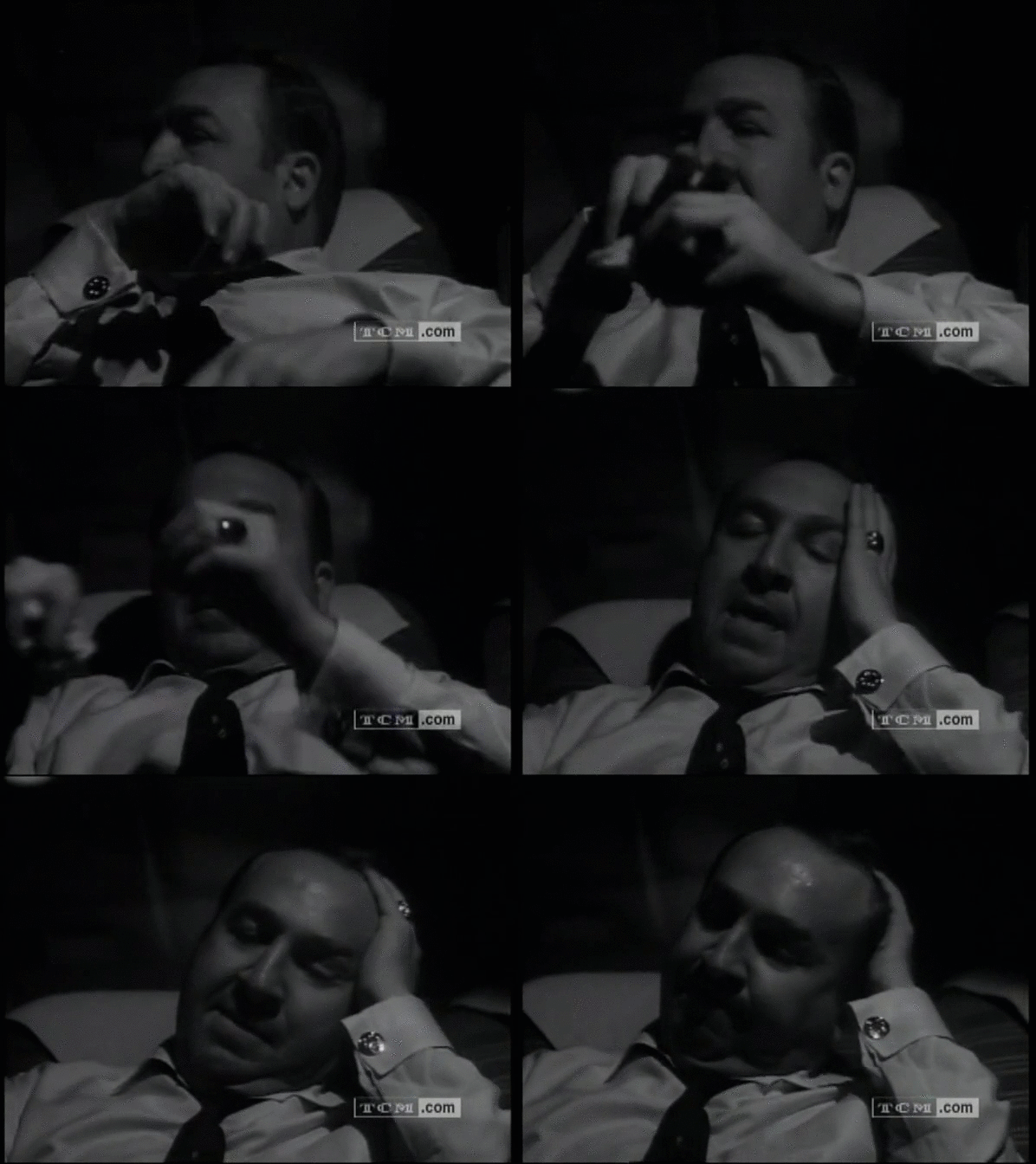
Meanwhile, Allan Dexter is leaving the family railroad because of his father's refusal to be innovative. This leads to a nice scene where the elder Dexter puffs his stogie like a locomotive and reminisces about trains of the past:
Allan Dexter goes to work at the dam in Nevada. Turns out that the men on the project are coming down with infantile paralysis, and no sooner does Allan get there than he passes out. Ruth has come to see him, but that's not enough -- he needs an iron lung immediately. Father Dexter is beside himself -- how to get an iron lung cross country toot suite? If only there was some sort of really fast train to take it!
The last third of "The Silver Streak" is all about the 100 mile-an-hour overnight race from Chicago to Las Vegas. Edgar Kennedy, God love him, steps in as an old school co-engineer and gives us several good examples of his burn takes in between thrill sequences like this:
There are lots of complications along the way, including close calls with oncoming trains, tricky curves and guys who almost don't get their handcar off the track fast enough. On board, meanwhile, Tom has to deal with hysterical passengers, an escaping murderer and, worst of all, Arthur Lake as comedy relief.
To the surprise of no one in the civilized world whatsoever, the Silver Streak makes it to Vegas, the train's future is assured, and Ruth and Tom make up.
In real life, by the way, the Pioneer Zephyr made headlines in May 1934, when it traveled from Denver to Chicago in about 13 hours, almost breaking the land speed record for that time -- and the engineer happily endorsed Camel cigarettes after his run.
The 1932 film "State's Attorney" and its 1937 remake, "Criminal Lawyer," are based on the same story by Louis Stevens.
But in the hands of different screenwriters working under different production codes -- and performed by lead actors with distinctively different styles -- you get two, well, different movies.
Stevens's story is about a flamboyant attorney who's the mouthpiece for a big-city gangster. Thanks to the gangster's influence, the attorney becomes the chief prosecutor and starts dreaming of the governorship. But then the gangster commits murder, and, thanks to the love of a good woman, the attorney risks the wrath of his biggest backer -- not to mention his life -- to see that justice is done.
Both films follow that plot. In the 1932 film, John Barrymore plays the attorney, named Tom Cardigan. In the 1937 film, Lee Tracy plays the attorney, named Barry Brandon.
The screenplay for the Barrymore film, "State's Attorney," was written by Rowland Brown and Gene Fowler. Brown was responsible for some tough, notable pre-code movies, including "Hell's Highway" and "Doorway to Hell." Fowler was a longtime Barrymore crony -- he kept vigil at Barrymore's deathbed and later wrote the Barrymore biography "Good Night, Sweet Prince."
So the character of Cardigan is very much colored by what seems like Barrymore himself -- a wisecracking blend of impishness and melancholy, with plenty of boozing thrown in. Barrymore slides from comedy to drama with great grace and style. He doesn't look like he's acting, which is the best kind of acting.
The Tracy film, "Criminal Lawyer," is likewise heavily colored by its leading man, which isn't necessarily a good thing.
Tracy's screen persona was that of a fast-talking operator who was often just this side of being a con artist. Barrymore knew how to let silence work for him; with the characters Tracy played, there aren't any moments of silence, because to stop talking meant that the rubes were more likely to catch on to your scheme.
Beyond that, the script for "Criminal Lawyer," written by G.V. Atwater and Thomas Lennon, is scrubbed clean of spice. Sure, there's crime aplenty, but very little of that sex stuff.
Both movies begin with a party thrown by the gangster -- in the 1932 film it's Valentine "Vanny" Powers, played by William Boyd, and in the 1937 film it's Larkin, played by Eduardo Ciannelli (seen with Tracy at left).
The party is raided, and we end up at night court. In both movies, the gangster orders the attorney to sweet talk the female judge into releasing the party without bail. But the attorney is feeling contrary, so instead he makes sure the judge sets bail -- at fifty bucks a person, which the gangster grudgingly pays.
Here is where things begin to diverge.
Next up on the night court docket is a woman -- in the 1932 film she's June, played by Helen Twelvetrees; in the 1937 film it's Madge, played by Margot Grahame.
Both women have been picked up for soliciting, although in the 1932 film it's much clearer. June, in fact, works for Vanny, which means he also does some pimping on the side. But as opposed to Vanny's well-heeled patrons, she really does need help, and Cardigan jumps in. First he reaches into his coat pocket, pulls out a wedding band, and slips it on June's finger. Then he stands before the judge and proceeds to pull on her heartstrings:
This is a pretty cynical scene, but Barrymore plays it completely straight and practically makes you believe him. As Brandon, Tracy isn't as conniving as Cardigan -- he doesn't carry a wedding band in his pocket. Madge is already wearing a costume jewelry ring, so he turns it so that its large setting is hidden and only the band shows. Oh, and Madge doesn't work for the gangster -- she's apparently a freelancer.
The way Cardigan cross-examines the cop who arrested June also has more of a pre-code bite. Seems the cop served a hitch in reform school, and if we don't get the point that he's a bad egg we hear that after being paroled he was sent back again for torturing a dog. In "Criminal Lawyer" we don't hear anything about that.
In both movies, the attorney ends up taking the woman back to his place. Cardigan gently removes June's coat and pours her a drink, and she asks him what he wants for breakfast in the morning. Brandon, on the other hand, wastes no time in getting Madge an apartment in his building. No impropriety (or breakfast, for that matter) here! June is pretty clearly kept by Cardigan, but not Madge -- she goes to work in Brandon's office, where she can gaze at him longingly.
Once they become chief prosecutors, both attorneys hitch their star to a headline-heavy murder case -- a housewife (named Nora Dean in the 1932 film, Nora James in 1937) is accused of killing her husband as he slept. Nora whoever contends it happened during a break-in. Both attorneys are determined to break down Nora on the stand, and the 1932 treatment is much more lurid than the 1937 one. Cardigan has the bed where the murder take place brought into the courtroom, so that the jurors can see the bloody sheets. Then he takes the murder weapon -- an iron sashweight -- and incessantly taps it on the metal bed as he questions the suspect. In the 1937 film, there are no such histrionics, and Brandon takes only about five seconds to elicit a confession from Nora:
Romantic rivals rear their ugly heads in both movies in the form of the spoiled daughter of a political kingmaker. In the 1932 film it's Jill Esmond as Lillian, who purrs lines like "to me there's something thrilling about a woman killing for love." She's hot to trot for Cardigan, who willingly (if drunkenly) marries her to ensure his political success, even if it means shafting June. Her 1937 film equivalent, Betty, played by Betty Lawford (Peter's cousin), is kind of wan, and she shanghais Brandon into marrying her.
In both movies, however, the woman's character is quickly disposed of because the attorneys quickly have second thoughts, and because the women have eager suitors waiting in the wings. And as luck would have it, both suitors are played by actors with tangential relationships to Astaire-Rogers musicals.
In the 1932 version, Lillian is wooed by Alvarez, played by Raul Roulien, who would also play Gene Raymond's rival for Dolores Del Rio's affections in "Flying Down to Rio." In the 1937 film, Brandon's romantic rival is Bandini, played by Erik Rhodes (left), the comic actor best known as the Italian gigolo in "The Gay Divorcee" and "Top Hat."
There's a scene in both movies where the attorney meets with the suitor and lets him know that he's cutting the daughter loose. In the 1937 film, it's done with lots of mugging from Rhodes, and in the 1932 version it's done over a glass of saline laxative -- see for yourself:
The dramatic climax of both movies comes when the gangster goes on trial for murdering a rival ("Bird Legs" Duffy in the 1932 film and "Bird Dog" Duffy in the 1937 film, if you must know). The murder was witnessed by June/Madge, but she won't talk for fear the gangster will harm Cardigan/Brandon. In the 1932 version, there's an even stronger reason for Cardigan to back off from prosecution -- he himself was a burglar and served time in reform school.
And the ending, the same in both movies, is what you'd expect for that time -- the attorney walks out of the courtroom with his self-respect intact, along with the woman who stood with him through thick and thin.
We'll close with one more moment from the Barrymore movie -- a drunken conversation between Cardigan and a carriage driver where Cardigan is plinking out the wedding march on a series of half-full glasses of beer:
The 1938 film "Next Time I Marry" isn't, and shouldn't be, a standout on the resume of anyone involved. Not stars Lucille Ball or James Ellison, or supporting players Lee Bowman or Mantan Moreland, or even director Garson Kanin.
And yet.
This is only Kanin's second film, and it offers several glimpses of the witty style he would demonstrate more convincingly in movies from "My Favorite Wife" to "Born Yesterday" to "Adam's Rib" to "Pat and Mike."
It also provides a nice showcase for Ellison, a leading man in the Joel McCrea mold who never achieved the same level of fame.
Ellison is remembered today, if at all, for playing Johnny Nelson, the sidekick of William Boyd in a series of Hopalong Cassidy westerns during the first half of the 1930s. By the late 1940s he was back in westerns again. But for a brief period, he played supporting roles in movies that were a cut above, like "Vivacious Lady," "Charley's Aunt" and "The Gang's All Here."
In "Next Time I Marry" he is Anthony J. Anthony, a forgotten man of the depression who is working on a roadside WPA project. Up pulls heiress Nancy Crocker Fleming (Ball) in her Duesenberg, looking for an instant husband. It seems that to inherit her fortune, she must marry a "plain American," and Tony Anthony seems as plain as anybody. Then her plan is to divorce Tony and marry her real love, the preening, freeloading Count Georgi (Bowman).
Tony's the freewheeling type -- he lives in a trailer he tows everywhere -- and he accepts Nancy's offer of cash. So they hie to the local justice of the peace, and Tony slips a ring on her finger that's made to hold car keys:
Nancy's scheme runs into the disapproval of her Uncle (Granville Bates, winding up for the kick at left), known as "Crock." He sees the Count for the four-flusher he is.
(Kanin must have appreciated Bates's comic ability -- he also cast him, to great effect, as the grouchy judge in "My Favorite Wife" who opens the movie by granting an annulment to Nick Arden (Cary Grant), whose wife Ellen (Irene Dunne) is presumed dead, and who closes the movie by granting a divorce to Nick because Ellen has turned up after all.)
"Next Time I Marry" is a road picture, and the travel begins after Tony and Nancy are married. She plans to head to Reno for a divorce, but Tony's pride won't let her make that move without him, so he "kidnaps" her and locks her in his trailer, and they both head to Reno. In retaliation, Nancy sets the trailer on fire, forgetting that she is in it. But Tony has everything in hand:
It isn't long before Count Georgi is in pursuit of Tony and Nancy, assisted by manservant Tilby (Moreland). The script isn't above some stereotypical humor at Moreland's expense, but there also is this very nice moment between Bowman and Moreland that involves interchangeable exchanges of "yassuh":
The group makes it way to the outskirts of Reno, where the Count hatches a plan. While Nancy distracts Tony, the Count will remove the license plate from the trailer, ensuring that Tony will be stopped by the law. Tony is about three steps ahead of the plan, but he's happy to let Nancy seduce him:
This movie marks the first time, I believe, that I actually laughed at Bowman in a movie. Seems like the guy almost always played the rival to the romantic hero, but here he's at least likably smarmy as opposed to just smarmy.
And what about Ball? Well, she smoothly steers her way through this movie in much the same way she did most of her films at RKO. She's the rock in this cast, totally committed to the role and the material. It's amazing to consider that by the time she hit television in 1951 with "I Love Lucy," she already had 18 years of film experience under her belt.
"Next Time I Marry" is available through the Warner Archive. Here's a preview:
In the 1933 film "Headline Shooter,"William Gargan and Frances Dee play news hawks who don't really care who they trample over to get to a story, and that is why they are awesome.
Gargan plays Bill Allen, a photographer for Phototone newsreels, and Dee plays Jane Mallory, a newspaper sob sister. Despite the entreaties of friends, family or even the victims themselves, Bill and Mallory -- everyone calls her by her last name -- are pros to the end, and they belong together like Hildy Johnson and Walter Burns in "His Girl Friday."
We first meet the fast-talking Bill as he's getting ready to photograph a beauty contest that will be judged by the head of the Crocker Cracker company, the honorable Franklin Pangborn. Bill has already shot a photo layout with a certain negligeed contestant in bed, eating Crocker Crackers, and he strongly suggests to President Pangborn that if said contestant wins, then a beauty queen will be endorsing Crocker Crackers.
Benchley's having trouble
with his stem.
Working next to Hobart Cavanaugh?
Sign me up!
The beauty pageant opens the film and we immediately see a cast of welcome faces -- Pangborn, Robert Benchley as the windbag doing pageant play-by-play on the radio, and Hobart Cavanaugh and Wallace Ford as Bill's fellow newsreel photogs.
Immediately after the beauty pageant, there is an earthquake, because Hollywood. And while he's acting all devil-may-care filming widespread destruction, Bill meets Mallory, and together they go looking for scoops. They share a cigarette or two, and then she has to find a way to get back to the paper:
Bill's always been one to play the field, but he can't get this dame off his mind, get me? And Mallory has to admit she likes him, too, but that's a problem, because fiancee Ralph Bellamy is waiting for her in her Mississippi home town. So Mallory scrams home on vacation, but Bill ends up there, too, because a substandard dam has busted and caused a flood.
At first, Bellamy -- the boring town banker, natch -- welcomes Bill and Mallory and hopes they tell the story of how corners were cut in the damn dam construction. But when the faulty work is traced to the town judge, the townspeople rally around him (and don't even try to talk to them about the negro situation). Allen is forced to destroy his incriminating film. Ya think he does it?
Meanwhile, Mallory gets back to town and her editor (our old pal Purnell Pratt) gives her a hot story -- a gangster's moll (our old pal Dorothy Burgess) is in the hospital and ready to sign a statement incriminating her boyfriend. So Mallory hotfoots it over and gets her story and the statement:
Then she leaves the hysterical moll in the hospital. Later, traitor!
But wait! Mallory is taken hostage by the gangster and his goons, and Bill and Ralph Bellamy leave no stone unturned in tracking her down. Once they find her, however, Mallory is more interested in phoning in an exclusive than in marrying Bellamy. This leads him to utter this heartfelt final statement:
Ralph Bellamy: I'm going home.
And, with the help of Bill, Mallory tells her story before the cameras:
Here are the complete credits for "Headline Shooter."
You never know when Nazis might make a comeback, so we turn to the 1942 film "Seven Miles From Alcatraz" for advice on what to do when goose steppers appear on your doorstep.
Greetings, everyone! My name is Champ. I am an escaped
prisoner and Nazi-fighting expert extraordinaire.
I also have a yen for yachting attire.
My story begins at Alcatraz, where my friend Jimbo and
I are sitting out World War II -- OR SO WE THOUGHT!
Our troubles started when we busted out of Alcatraz one night.
The movie's budget isn't big enough to show you how we
actually did it.
All you get to see is the packing crate we hid under
to make our escape. As as inside joke, they put the name
of the producer on the crate. That's why the prop guys had
so much fun shooting holes in it.
We ended up at a lighthouse that was SEVEN MILES
FROM ALCATRAZ. Here we found the captain, his
daughter Anne and comic sidekick Stormy. aka the voice of Jiminy
Cricket. We punched him out because "Pinocchio" made us cry.
Meanwhile, in San Francisco, several Nazis were getting
ready to head our way and rendezvous with a German sub.
I started warming up for the big fight the way I used
to with Jimbo back on the Rock.
Once the Nazis arrived, the other folks didn't quite know
how to fight them.
"Go away or I'll sing 'When You Wish Upon a Star"!"
"Go away or I'll throw myself off the top of the lighthouse!"
"Go away or I'll kiss this girder!"
Things were getting weird. And when one of the Nazis
unplugged the radio because he didn't like "Fibber McGee
and Molly," well, that was the last straw.
It was time for some Badly Choreographed Fighting...
... and for me to say witty things like, "Watch that first
step, Adolf! It's a lulu!"
Then it was all over. The Nazis were captured and Anne
said she'd wait for me to get out of prison. She's not
quite as cute as Jimbo, but she'll do.
And yet, it seems the last laugh goes to our Nazi friend. He
escaped, hid out in Hollywood and re-emerged in the 1960s
as the beloved Sgt. Schultz on TV's "Hogan's Heroes"!
So stay vigilant, America, and remember -- today's TV star
might become tomorrow's Nazi. Lookin' at you, Charlie Sheen!
Our hero is Robert Ryan, as a brilliant but renegade
pilot who refuses to wear his earphones correctly. (Sorry for the borrowed joke.)
On board his flight is the Maytag repairman ...
... future Bat Masterson and his fiancee ...
... George Bailey's mother ...
... and Lassie's master, Timmy.
Also aboard is Anita Ekberg as a party girl. She is
upset because the airline charged her extra fare
for her eyebrows.
And finally, there is a condemned man onboard. He is
being put to death for impersonating Marlon Brando.
"Make him an offer he cannot refuse."
The flight is delightful ...
... even though one of the flight attendants walks off the job.
The plane makes a forced landing in an extremely isolated
place where no man dares to enter -- Cher's backyard.
"The horror. The horror."
"Please, God, let Anita Ekberg be my stepmother."
Everyone begins to bond. Ryan offers to let one of
Ekberg's eyebrows fly free.
And Bat Masterson's fiancee likes the co-pilot's
landing gear.
This leads to an argument about whose boyfriend is cuter.
But wait! There is a dark hand pushing aside artificial leaves,
which is the universal symbol of the headhunter.
"I coulda been a contender. I coulda been somebody
instead of a bum, which is what I am."
The passengers work together to try and throw the plane
into the air. There is only one working engine, so some
passengers will have to stay behind to keep the weight down.
"Sorry, kid, but it's either you or me."
No, just kidding. The group takes a vote on who will
be left behind, and the decision is unanimous.

 As a film, "The Silver Streak" sends a much simpler message -- work hard, be handsome, develop a streamlined train, and you end up winning Loretta Young's sister. But it's a fast-moving B movie that's very much a product of its time, with lots of cool location footage of the Zephyr, the Chicago World's Fair and Boulder Dam (with real workers in bit parts).